Brass handles are a different beast from copper.
In the world of French vintage copper, there were chaudronneries, the coppersmiths, but also the dinanderies, the metalworking shops that made decorative items out of brass and bronze and, notably, the brass handles that were riveted onto many copper pots and pans. But here’s the thing: not all chaudronneries were also dinanderies. A coppersmith may not have had the capability to custom-cast brass as well, in which case it would have bought handles from another coppersmith or from an independent brass-works. (Brass handles are interchangeable between pots and pans of the same diameter, which is why different copper manufacturers could use the same handles.)
I have been attempting to study the design of brass handles between different makers in order to identify differences that could help identify the maker of a pan, but for the most part, I have failed. What I can offer you on this page is a running list (with photos) of the handle designs I have come to recognize and associate with a particular era or, much more rarely, a maker.
In each section I will order the handles in rough chronological order (as best as I can establish it).
Part 1: Brass side handles
These are the handles you find on the sides of stockpots, stewpots, rondeaux, and other cylindrical pans, and occasionally as a helper handle on a saute or saucepans.
 |
Likely 1870s-1880s. |
 |
1880-1890. English style. |
 |
1885-1893. This is the earliest example of what I call the “Classic French” that I can date with confidence to the 19th century. |
 |
1890s-1900. This is Classic French. |
 |
1890s. This is Classic French. |
 |
1914-1920. This is Classic French. |
 |
1920-1930s. This is Classic French. |
 |
1960s-1990s. This is post-WWII Modern French; note the very yellow brass. |
 |
1970s-1980s. This is Modern French. |
 |
1970s-1990s. This is Modern French; note the straight prongs of the handgrip. |
 |
1970s-1980s. This is Modern French from a Mauviel Cupronil nickel-lined stewpot. |
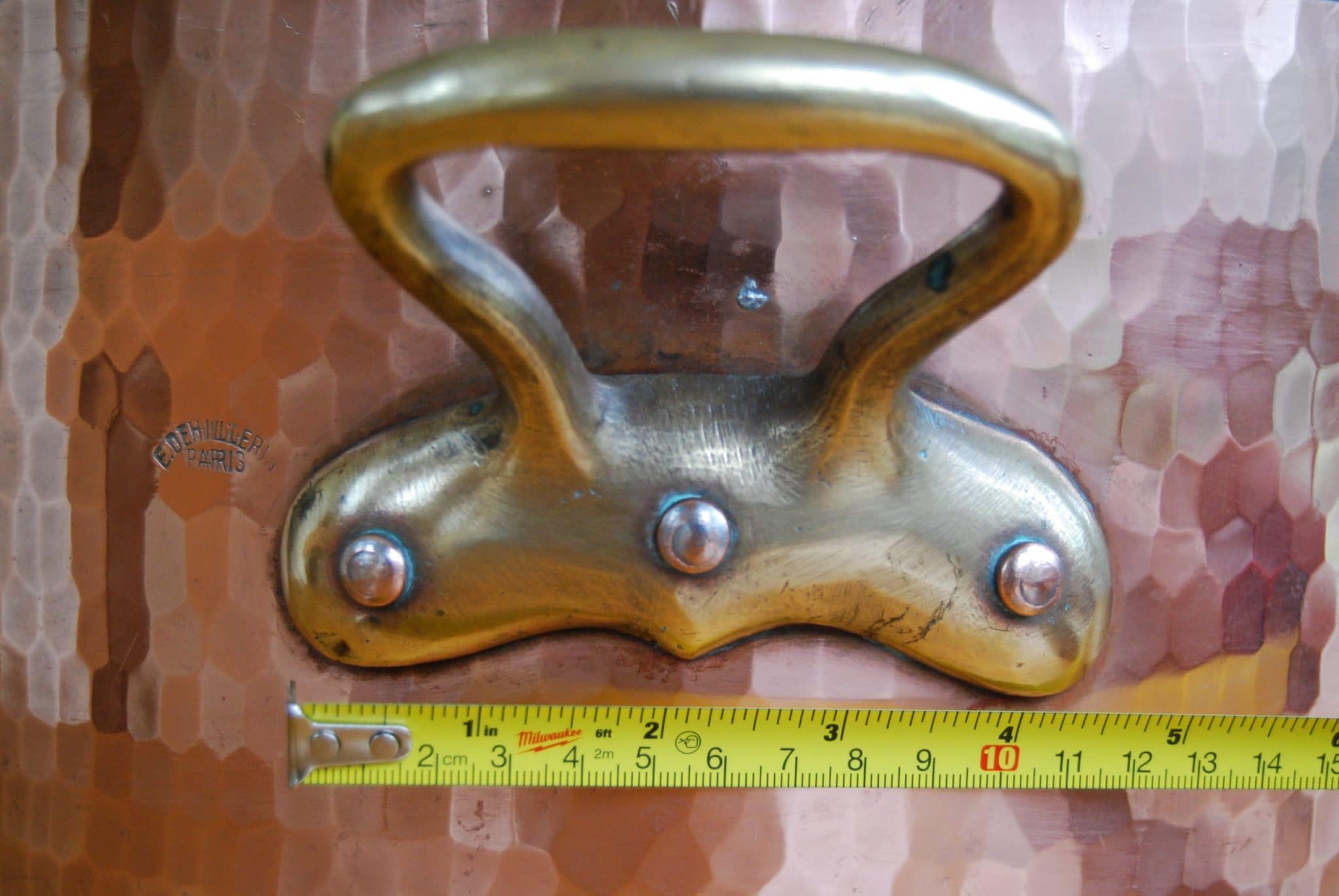 |
1970s-1990s. This is Modern French. |
 |
2020s. |
Part 2: Lid handles
 |
1880s-1900 |
 |
1880s-1900 |
 |
1895-1910s. This is Classic French. |
 |
1920-1930. This is Classic French. |
 |
1960. This is an early example of Modern French. |
 |
1970-1990 This is a version of Modern French. |
 |
1970s-1990s. This is Modern French. |
Part 3: Stick handles
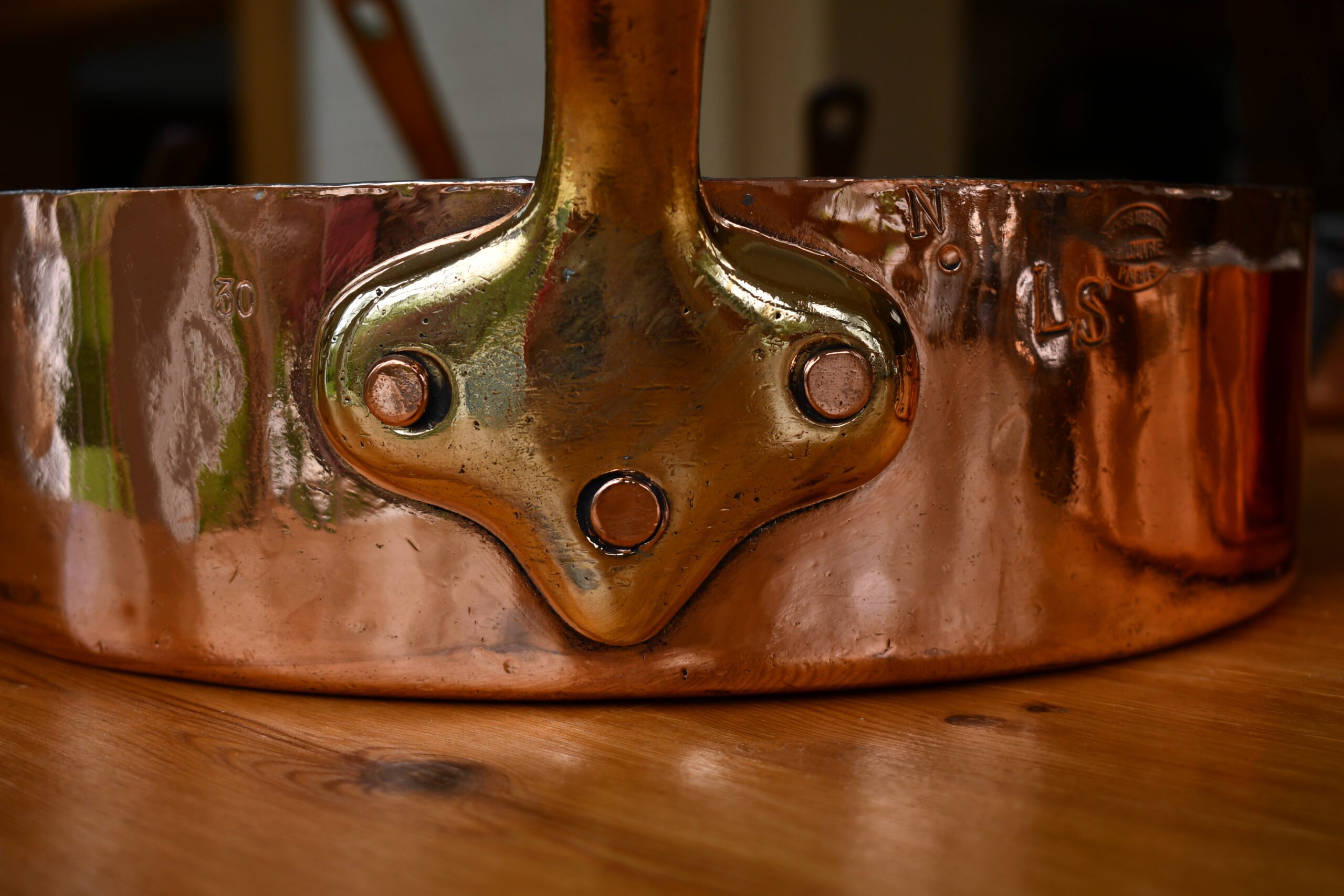 |
1887-1914, only for Grands Magasins du Louvre. |
 |
1873-1908, only for Allez Frères. |
 |
1920s. This is Classic French. |
 |
1990s-1990s. This is a very common Modern French handle design and is very difficult to date. |
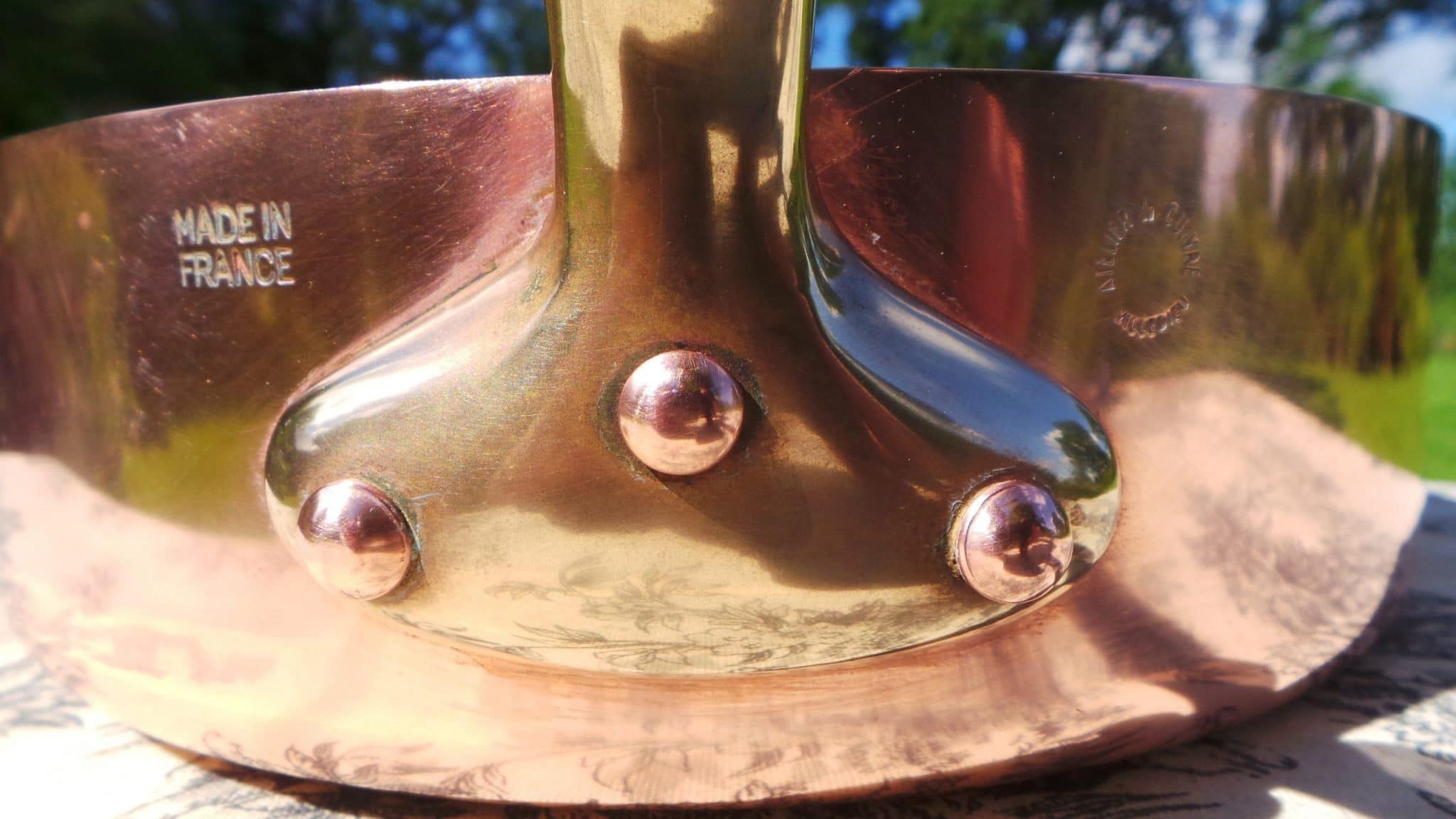 |
1970s-2010s. This is another Modern French style that is very common and found on all kinds of pieces; Mauviel continued to use it until 2015. |
 |
2010-2020s, only for Mauviel. |
 |
2010s-2020s, only for Mauviel. |
Part 4: General observations to help identify the age of a piece
Ornate handles are more likely to be 19th century to early 20th. Design flourishes such as surface details, exaggerated points, and other unnecessary fripperies are of an earlier aesthetic. The French copper cookware manufacturing industry underwent a Great Consolidation at the end of the 19th and into the early 20th century and handle designs settled into a few standardized designs.
Well-finished handles are more likely to be 19th to early 20th century. A good professional copper cookware maker would examine the brass handle prior to attaching it and ensure that rough edges were smoothed away with a file.
Lid handles with one rivet per bracket are more likely to be post-WWII. I think this was a cost-cutting move during a time of material scarcity.
Dull or off-color handles are more likely to be from WWII into the 1960s. The chaudronneries who managed to survive WWII faced a decade of material and manpower shortages after the war. If the brass looks cheap and low quality, it may very well have been cast from an inferior grade of alloy.


Hello, Great review here even though there is a lot of uncertainty. I’m inspired to more thoroughly photograph the handles of pans before I sell them.
I’ve been noticing a lot of variation on the texture of brass handles from very rough on some Matfer and Bonjour stamped pieces, to very smooth polished brass on other pans (usually MIF stamps).
Would love to get your thoughts on those.
Thanks,
Cameron
Hey Cameron! My immediate thought is that Matfer and BonJour are likely Mauviel of a similar period, so their handles may be from the same stock. I have noticed a “rough period” in mid-century Mauviel work — yellowy metal, rough flat planes, no smooth shine. This page is a work in progress and I’m thinking about reworking it. I fear it’s pretty much a photo gallery without a lot of useful information, and I think I can improve it. (I’ve also learned a lot in the time since I put it together.) I’ll put it on my list of pages to revise.
We are wondering what the ornate braided brass handles on our set of tin lined copper pans might tell us about the maker and date of origin. Is there a way to send you a photo?
Thanks,
Suzanne and Lanse Holmes
Hi Suzanne! I’d be happy to take a look. I’ll send you an email in a moment. Thanks!
Your articles are very interesting and informative. I am wondering about the stamps on two copper pots that were given to me and that I am planning to sell. May I send you photos and would you be willing to help me identify them?
Thank you,
Nancy
Hi Nancy! Sure — I’ll send you an email.
Hello. I’ve been looking for information on a copper fish pan which has no rivets on the handle, something I have never seen before. Is this common? Thank you!
Brass handles are also often found on roasting pans, where they form other groups. I was particularly struck by a handle design that apparently convinced all major manufacturers for well over 100 years! A rare constant in copper cookware. I found this handle basically unchanged on roasting pans made by well-known manufacturers such as Briffault, Gaillard, Dehillerin, Jacquotot and Mauviel between about 1880 and 2010. The double curved rounded handle opens with discreet “arrowheads” into a long rectangular but relatively narrow support plate, which in turn is attached to the roasting pan with 3 rivets. It was not until 2014/15 that Mauviel made a change to the design of these handles in the traditional series. First, the transition from the actual handle to the support plate was smoothed (i.e. the “arrowhead” was removed) and a few years later the handles were only attached with 2 rivets.
It would be useful to add at least this further handle design to the post.