This venerable Villedieu maker lives on today as Atelier du Cuivre.

The name Lefèvre is Old French: it contains the word fer (iron) and means blacksmith or ironworker. It is fitting, then, that the Lefèvre family has been in Villedieu-les-Poêles since at least the early 17th century. The extended Lefèvre family tree is well-foliated with Villedieu chaudronnier families that I recognize from my research, including Mauviel, Huard, Picot, Enguerrand, Lemonnier, Tetrel, Vigla, and Loyer; the earliest traceable ancestor in the lineage of Lefèvre Frères is Guillaume Lefèvre who died around 1672 (birthdate unknown). From him, an unbroken line of Lefèvre sons carried the name forward to the 19th century. (If you’re curious, you can see the lineage here.) Through all these generations, the Lefèvre coppersmiths seem to have worked in the busy Villedieu ateliers of others, as I do not see a chaudronnerie of their own.
Lefèvre Frères (1900–1910?)
That changed in 1900. Pierre Émile Lefèvre (1845–1913), chaudronnier and great-great-great-great-great grandson of Guillaume, had three sons: Victorien Joseph (born 1875), Armand Auguste (1881–1935) and Édouard Émile (1885–1915). I believe these are the brothers who founded Lefèvre Frères: Victorien would have been about 25 in 1900, Armand perhaps 20, and Edouard just 15. From the start, the firm focused on supplying the restaurant industry with extra-thick cookware that was martelé (hammered on the exterior surface) for resilience, as shown in the brochure below.

Early on, the company captured a very prestigious client that would have boosted their reputation: Compagnie Internationale des Wagons-Lits, or CIWL. This French railway company operated from 1874 until the 1960s with routes and hotels across Europe, including the famous Orient Express. The CIWL’s luxury trains offered haute cuisine cooked in kitchens at the end of the dining cars, and the hotels served travelers and tourists looking for reliably excellent French fare. Lefèvre Frères supplied copper pots and pans for CIWL’s dining cars and hotels, which would have been a significant boost for the company. (Perhaps Pierre Émile, 55 years old in 1900, helped win the contract and handed off the work to his young and hardy sons.)
All three brothers married within a three-year span: Victorien in 1906, Edouard in 1907, and Armand in 1908. But towards 1910 there was also loss; Armand and his wife lost a son in infancy in 1909, and Victorien and his wife lost their second infant daughter in 1910. The brothers’ mother Marie Celestine passed away in 1908 followed by Pierre Émile in 1913. And then in 1914, the French government called all able-bodied men between the ages of 20 and 40 to mobilize for war. Youngest brother Édouard answered the call and in 1915 was killed at Les Islettes along the supply line to the battlefront in Verdun — mort pour la France, died for France.
Around 1910, amid this personal and national upheaval, Lefèvre Frères transitioned to A. Lefèvre. The company of brothers dissolved and Armand assumed sole leadership.
A. Lefèvre (1910?–1935)
The photo below of A. Lefèvre’s display at an exposition in Villedieu in 1924 gives us a wealth of information about how the firm operated. The placards on the wall read “A. Lefèvre, chaudronnerie industrielle” (industrial coppersmith), working with cuivre rouge (copper), laiton (brass), and aluminium. The display shows the breadth of offerings: towards the left we see stovetop cooking pots, utensils, and decorative items, and towards the right, restaurant-scale equipment in copper and aluminum, boilers, and other specialized components.

And most fascinatingly for me, along the back wall is a demonstration of the progressive steps of deep drawing a large copper pot. Look at the large round disc propped up with white writing on it — it’s a copper blank. The circular shapes along the back wall to the right show the series of numbered steps as the disk is pressed: steps 1 and 2 form a conical shape; steps 3 and 4 press the pan more deeply; step 5 is the shaped piece ready for hammering and polishing, and stacked upon it, the chaudron fini, finished pot.
One last element of interest: the French script on the copper blank reads, “Disk of red copper to make a farm cauldron, capacity 70 liters [18 gallons]. Value of the copper, 92 francs [US$91].” This message was aimed at restaurant suppliers: we can turn a 92-franc disk of copper into a pot that you can sell for much, much more.
That was the heart and soul of the Villedieu copper industry: busy production lines manned by experienced craftsman who cranked out cookware to order. A. Lefèvre occupied a cavernous stone workshop on Avenue Général Huard, named for a hero of the Napoleonic wars born in Villedieu in 1770. The two photos below of the Lefèvre workshop are undated but they have a 1930s feel to me.


In October 1935, at age 54, Armand remarried, and in December he left the company. I do not have a date of death for him but I hope that this was a happy and well-deserved retirement. It was a good moment for A. Lefèvre: The restaurant scene in Paris in 1935 was the economic engine that had enabled Villedieu’s copper industry to weather the Great Depression while the larger French economy struggled. Armand’s brother Victorien, aged 60, stepped in to continue the firm alongside his young nephew Maurice Lefèvre, 22 years old, born in 1913 to Édouard Lefèvre just before he was killed in the war.
Établissements Lefèvre Frères (1935–1980)
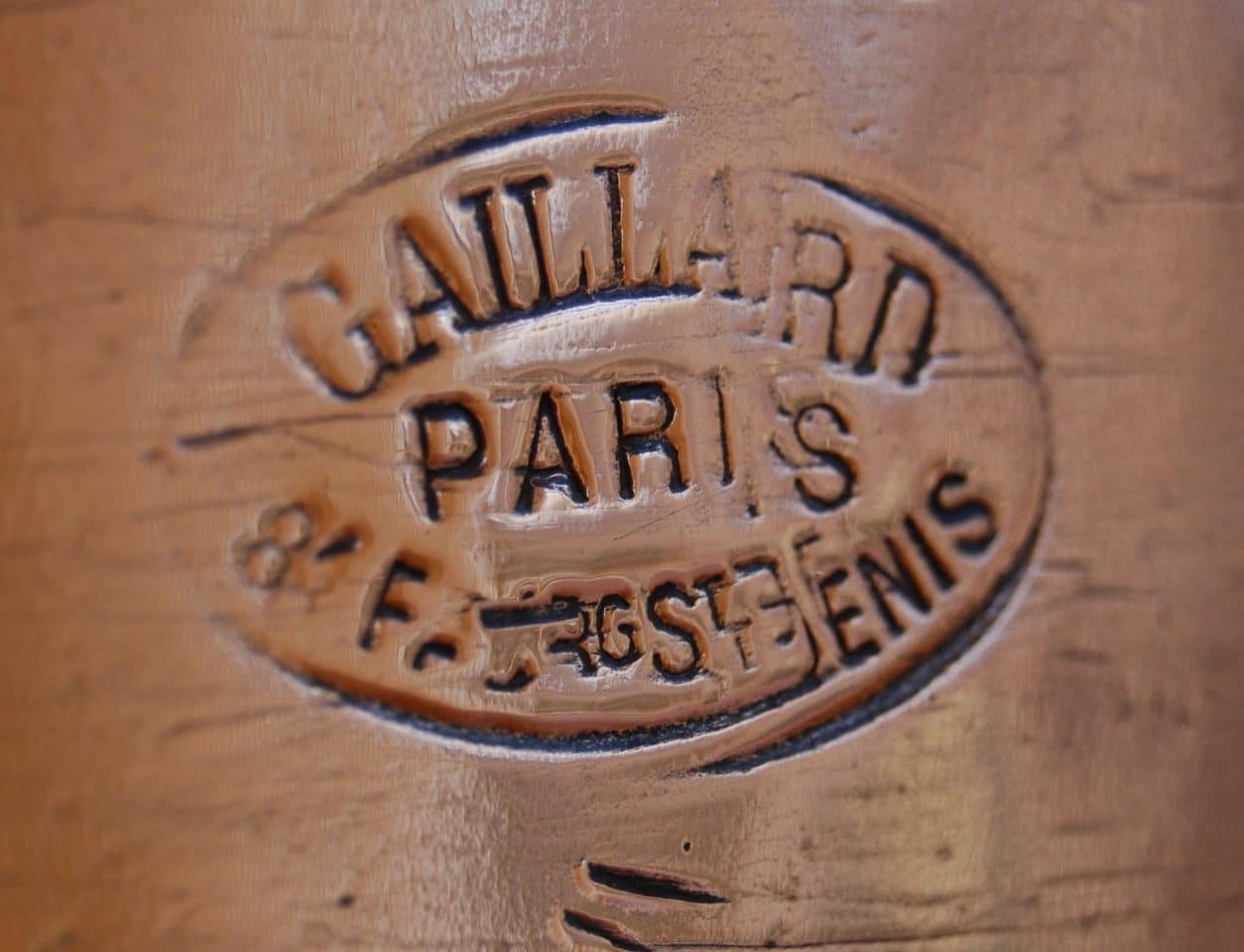
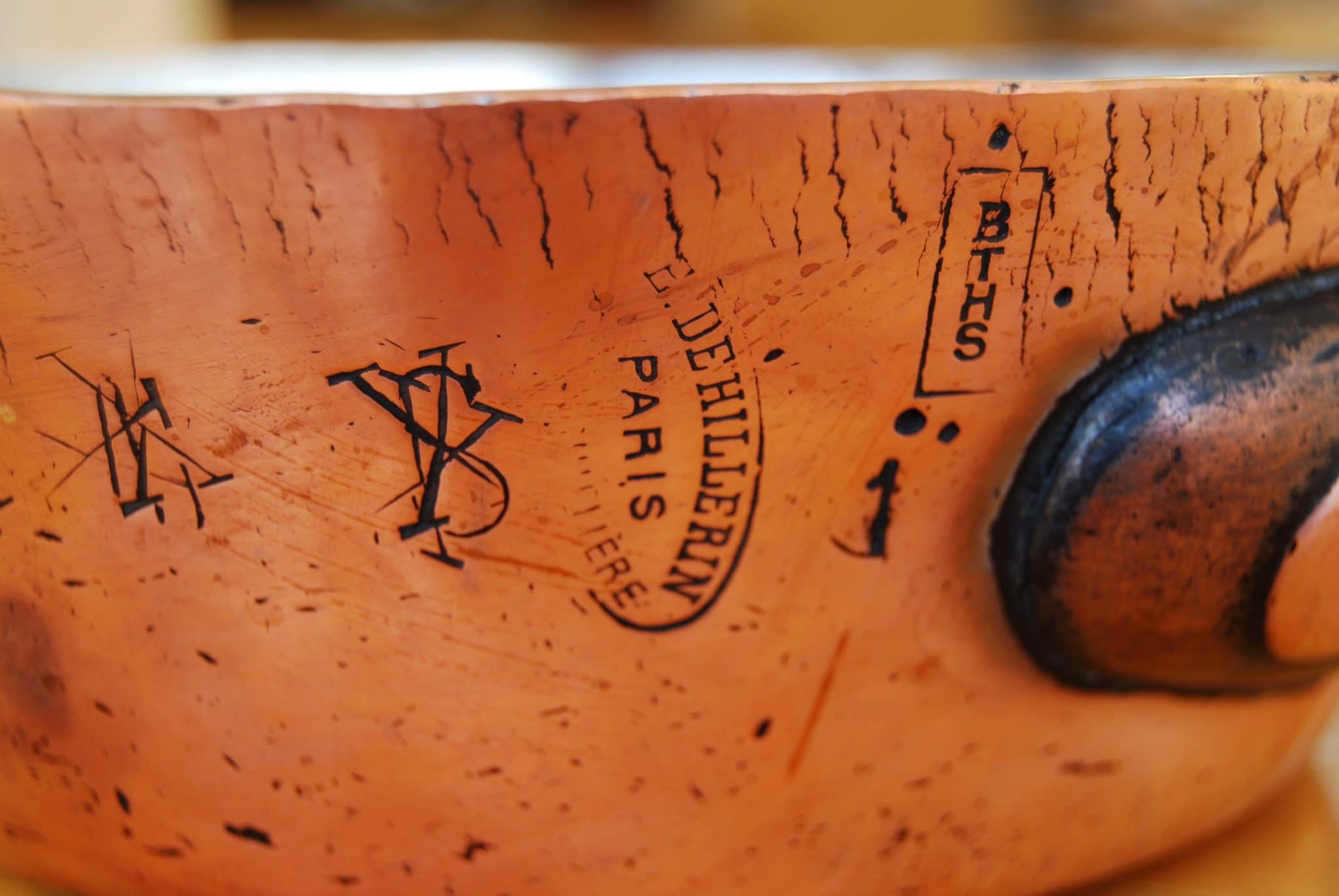
Maurice re-established the business as Établissements Lefèvre Frères, recalling the earliest era of the company while bringing it into a new era. He led the firm through WWII and into the trente glorieuses — the thirty glorious years of French economic recovery and prosperity from 1945 to 1974. I consider this the start of the Renaissance of French cookware industry: French cuisine became a global cultural phenomenon, and glittering copper cookware was its symbol. Lefèvre Frères did not put its own name on its copper but was a key supplier to Dehillerin, Gaillard, Jacquotot, and other kitchen and restaurant supply retailers in France.
In 1975, at age 62, Maurice brought in Étienne Dulin, age 27, to help run the company. Étienne brought vision and energy to the firm, perhaps reminding Maurice of himself at age 22 forty years earlier. In 1980, Maurice retired and sold the company outright to Étienne.
Atelier du Cuivre (1980–present)
With the retirement of Maurice there was no longer a Lefèvre in charge, and Étienne saw the opportunity — and perhaps necessity — to rebrand the enterprise. He renamed the company Atelier du Cuivre — the Copper Workshop. (I do note that the company traces its founding to 1850, which well predates Lefèvre Frères in 1900; perhaps Étienne recalled Jean Baptiste Lefèvre [1799–1858], though as above I have as yet been unable to locate a Lefèvre chaudronnerie of that era.)
Étienne recognized that the firm’s rustic stone building was not a jumbled relic of the past but instead a way to showcase the art of hand-crafted coppersmithing and preserve it for the future. In 1985 he opened the building to the public as an atelier vivant (living workshop) and it was a sensation. Said Etienne in 2018, “The idea was an immediate success, and in thirty-three years, we have welcomed a million visitors. Our record attendance dates back to 1990 with 45,000 visitors.”
Photos from that era give a vivid sense of the experience. The rectangular building with its vaulted wooden roof looks little changed from the 1900s.

 On the right is a photo of a wall with much-used hammers and mallets. Note the variety of shapes of the hammer heads; elsewhere on the site I discourse at length about martelage, the process of applying all-over hammering to machine-shaped pieces (which is exactly what these smiths are doing). Copper with hand-applied martelage can show strike marks of various sizes and shapes according to the shape of the hammer, and as you can see at right, a smith had many from which to choose. (Machine-applied martelage uses a powered piston and results in much more consistent strike shapes and patterns.)
I particularly enjoy photos of the chaudronniers in their bleues de travail (working blues) — the quintessentially French coveralls that industrial workers wore throughout the 20th century. I especially appreciate the gentleman below on the right.

Here he is in a sort of action sequence, going about his work hammering and soldering with the calm imperturbable focus that only a French ouvrier (workman) can sustain under observation.


The reinvigorated company prospered. In 1987 Etienne received a national award for entrepreneurship and two of his workmen — Jean Pierre Couget and José Segonne — earned the prestigious title of Meilleurs ouvriers de France (best workmen in France). I like to think that Maurice Lefèvre, retired after 45 years, appreciated the transformation that Etienne had accomplished. For a time, Maurice ran a one-man shop as ML Villedieu before passing away in 1989 at age 75.
 In 1990, Etienne set up a storefront at 111 avenue Daumesnil in the Viaduc des Arts (Walkway of the Arts) in Paris, which evolved in 1995 into the Atelier des Arts Culinaires (Workshop of Culinary Arts). This outpost in Paris is a storefront for the shop’s copper products as well as a site for repair and retinning. Atelier du Cuivre’s business evolved beyond traditional copper cookware and into architectural elements such as copper bar tops, bathtubs, and sinks, as well as maintenance of the copper cookware of high-end restaurants and the Élysée Palace in Paris. Said Etienne in 2012, “I go to Paris every week, where I secure most of my contracts by working with designers and interior architects. It’s also from the capital that the cookware of Parisian chefs is shipped back to be restored in the Villedieu workshop.”
But time marches on. Towards 2017, Etienne began to make noises about wanting to sell the firm to the right buyer so that he could retire. In March 2021, age 73, he sold the company to Jandelle Paris, a metalworking and design company that traces its history to 1902. According to CEO Yannis Groell, “Jandelle Paris Group is specialized in luxury decorative products in precious metals, particularly well known in the prestige kitchen and bathroom market through five renowned historic brands (Jandelle Paris, 1902, Gaillard Paris, 1795, Jacquotot Paris, 1908, Lefèvre Paris, 1850, Atelier du Cuivre, 1850), which enjoy an international reputation with an exclusive and demanding clientele (EPV “Entreprise du Patrimoine Vivant” & MOF “Meilleurs Ouvriers de France”).”
I have to say, if Jandelle had the vision to buy up Gaillard and Jacquotot, then Atelier du Cuivre and its Lefèvre legacy are in good hands. I look forward to seeing what the company does with this heritage.
The stamps
Lefèvre Frères (1900–1910?)
 I have come across relatively few copper pieces with the Lefèvre Frères stamp and they all have the same oval cartouche with the words CHAUDRONNERIE LEFÈVRE FRÈRES VILLEDIEU (MANCHE). Readers, if you have ever seen a different version of Lefèvre stamp, I would love to feature it here.
 Almost all of the stamped Lefèvre pieces I have seen (I would say all, but my memory is imperfect) are associated with CIWL. You can recognize these pans by the letters “WL” for Wagons-Lits stamped on them, sometimes along with other letters or numbers identifying a hotel, route, and sometimes even specific dining car. A Lefèvre piece with the WL stamp will be a workhorse: thick, sturdily built, and usually bearing scars and scratches from heavy use in a cramped and busy kitchen.
A. Lefèvre (1910?–1935)
I have never seen a stamp for this firm. I suspect they operated strictly as a supplier for others. If you ever come across a piece with a stamp for A. Lefèvre, I would love to share it here.
Etablissements Lefèvre Frères (1935–1980)
Sigh. Again, no stamps that I am aware of.
Atelier du Cuivre (1980–present)
Atelier du Cuivre pans are easily identifiable by their stamp.
| This is a simple round cartouche with the words “Atelier du Cuivre” above and the word Villedieu below. | 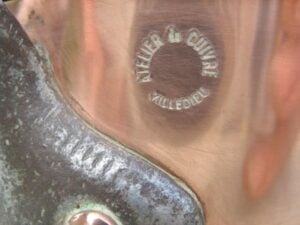 |
| This is another configuration of the round cartouche. In this version, the words Atelier du Cuivre are arranged in three lines above the word Villedieu. | 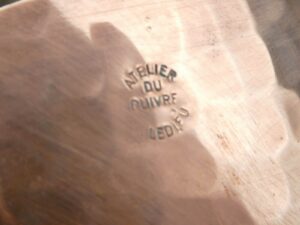 |
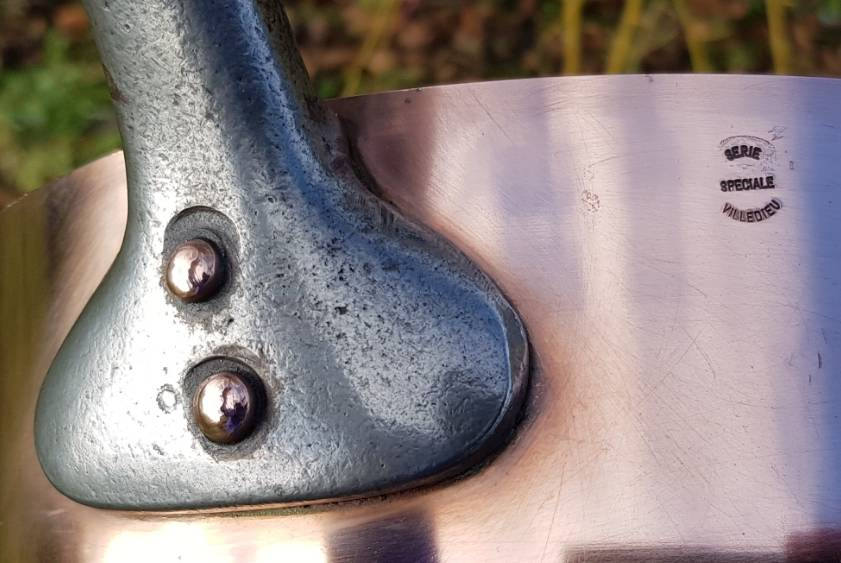
| “Serie Speciale Villedieu” are tin-lined pans. I believe these are products of the Atelier du Cuivre from an example with this stamp and second “Atelier du Cuivre” stamp on the same piece, but that may have been an oddity. I’m still looking into this and if you know more I would welcome the information so I can correct this. | 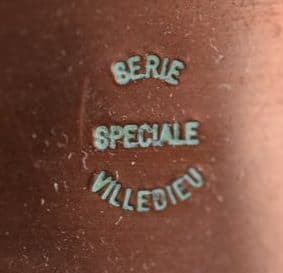 |
| This stamp reproduces the company’s current logo. I think this is the most modern version of the stamps. | 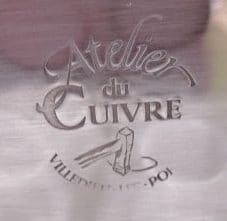 |
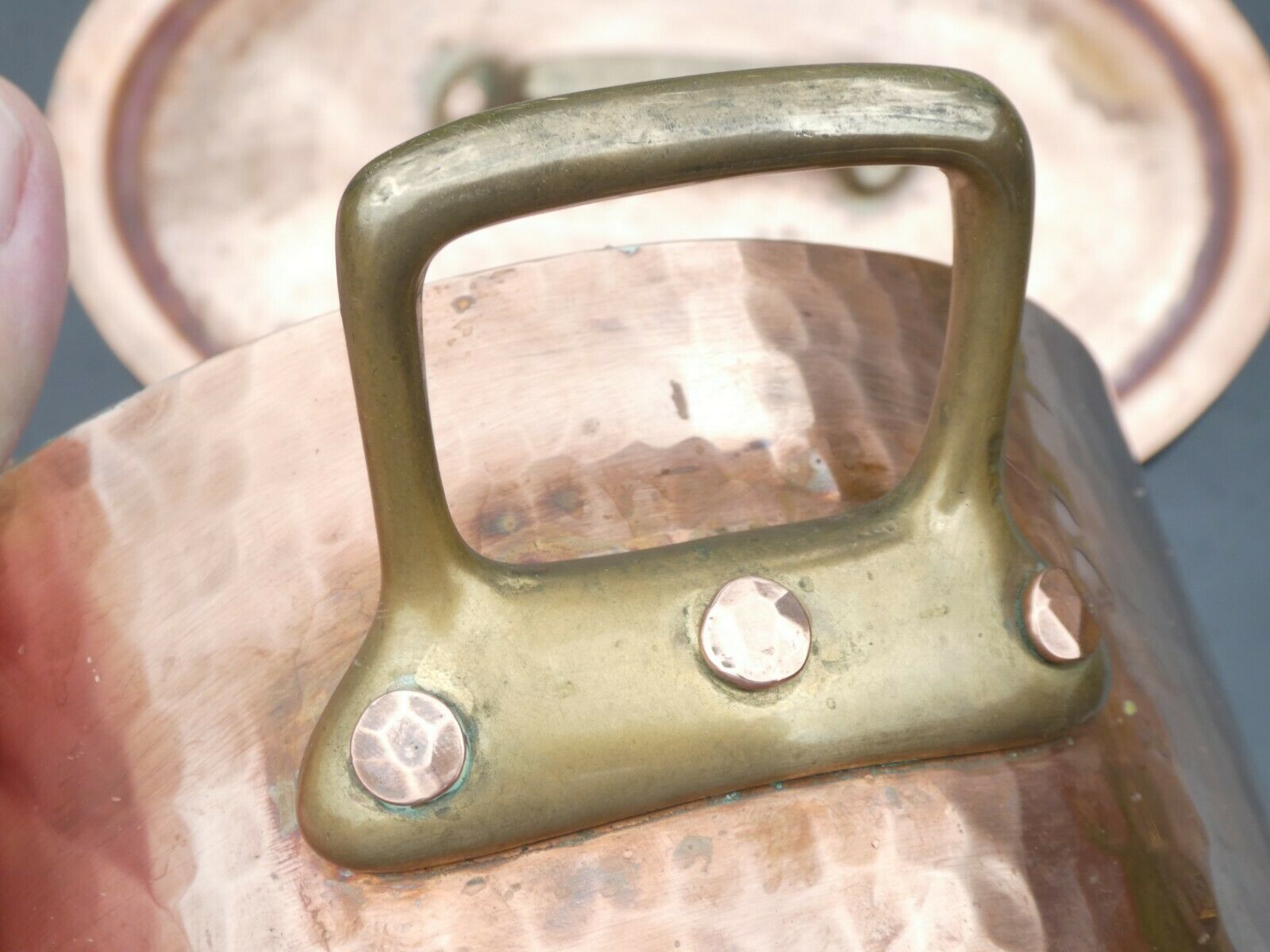
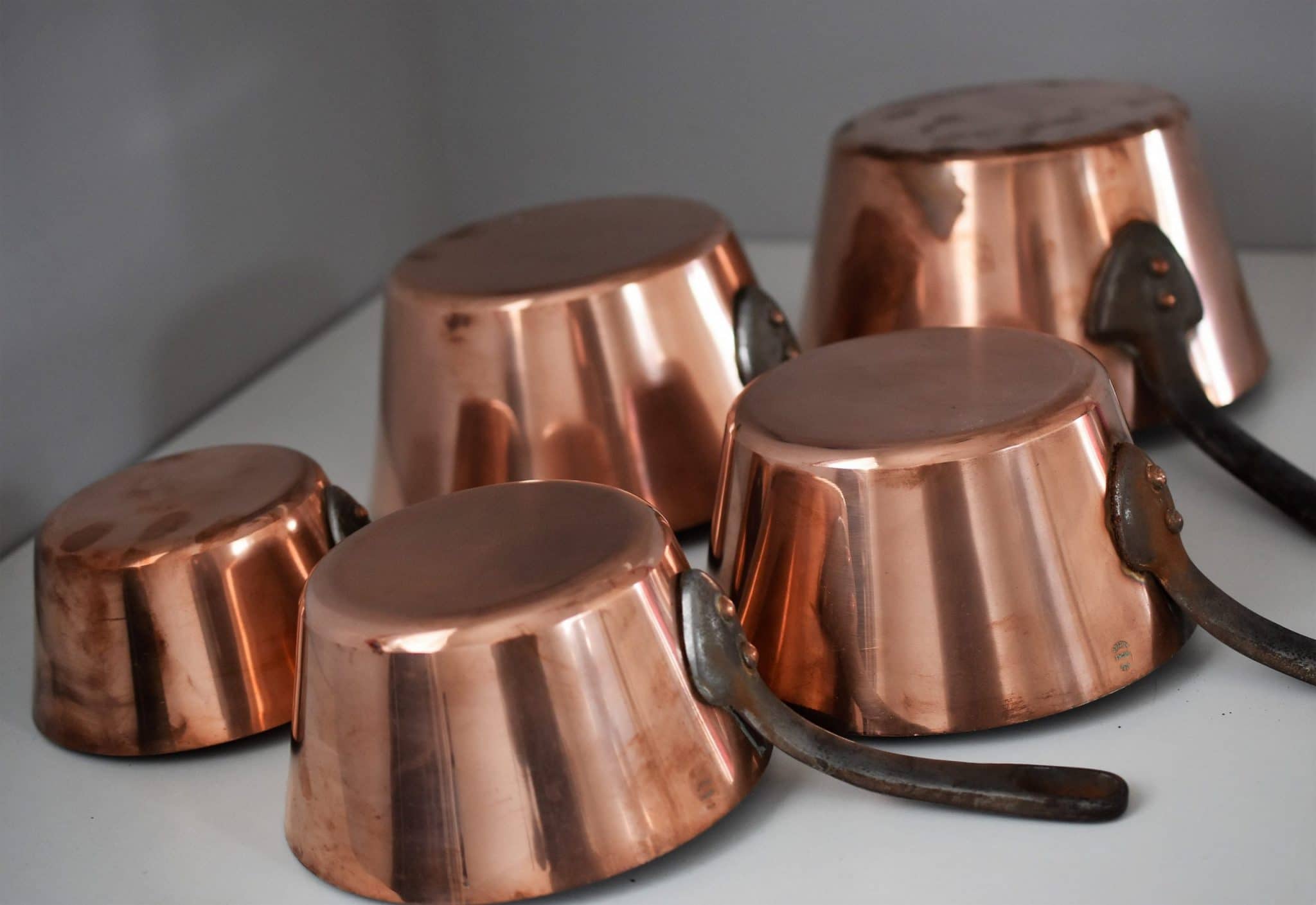
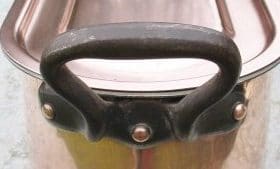
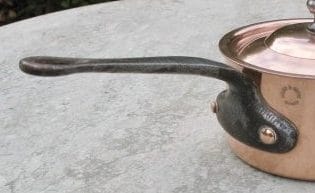
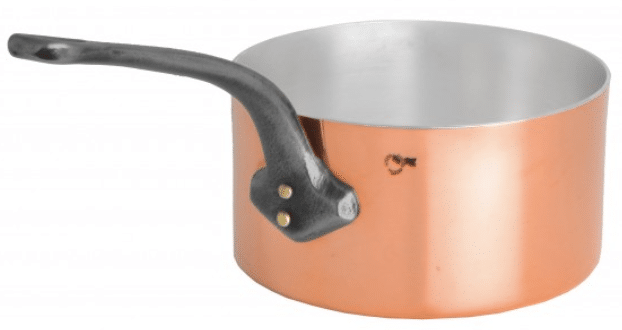
Atelier du Cuivre’s iron handle designs vary. In addition to conventional two- and three-rivet handles, the company also brazes or welds their handles to the exterior of the pot, producing a smooth rivetless interior. (I believe Multiform does this work for them.) The “Serie Speciale” pieces often have two-rivet handles in a vertical orientation, either fully riveted or welded.
Conclusion
I hope this field guide is of use to you, and that the history of Lefèvre helps you appreciate Atelier du Cuivre in the present day. I cherish my Lefèvre Freres pans with the “WL” stamp because they offer the best of antique French copper: a fascinating provenance, elegant construction, and above all, super-thick copper. I am so glad that Maurice Lefèvre and Étienne Dulin ensured this legacy’s survival into the 21st century.
And finally, I am gratified to see Jandelle Paris listing Lefèvre Frères alongside Gaillard and Jacquotot as the greats of antique French copper! The VFC community has always known this to be true! Long may they reign!
Sources
I had a devil of a time pulling together information for this field guide. Lefèvre is a common name in France and I went down many dead-end rabbit holes trying to track down facts about the family. There is also a general information gap prior to 1980, and I had to piece together information from a range of recent French-language news stories and make some inferences; I regret any errors I have made. Here are links to some of the more helpful news stories (with titles translated to English).
- Étienne Dulin, a dynamic 64-year-old boss (Ouest-France, 08 August 2012)
- Villedieu’s activity was dominated by copper in the 20th century (Ouest-France, 16 August 2013)
- Étienne Dulin: over 30 years in the service of copper (Ouest-France, 16 August 2016)
- In the copper workshop, Étienne reveals his secrets (Ouest-France, 26 June 2017)
- At the copper workshop in Villedieu: 80 years of ownership between the two of them (Ouest-France, 19 July 2017)
- Étienne Dulin: 30 years of expertise in the copper workshop (Ouest-France, 18 August 2018)
- Atelier du Cuivre. At 70, Étienne Dulin is waiting for the “right” buyer. (Ouest-France, 31 August 2018)
- Atelier du Cuivre in Villedieu: Étienne Dulin takes his final bow (Ouest-France, 15 March 2021)
- Normandy. The coppersmith Étienne Dulin forged the reputation of the copper town of Villedieu (Ouest-France, 02 April 2021)
- Villedieu-les-Poêles. Jean-Louis hangs up his apron after 44 years at the copper workshop (Ouest-France, 11 May 2021)
- The Copper Workshop: the art and passion of working with copper (Flash Matin, undated)
- Atelier du Cuivre (Villedieu Tourisme, undated)
- Atelier du Cuivre (Normandy Tourism, undated)