I’ve pulled some information together into an ongoing Buyer’s Guide geared towards helping you evaluate vintage copper and decide what’s right for you. (Are you a copper seller? I have a few tips for you, too.)
Start here!
I’ve put together some pages that I hope can help get you started.
- Frequently Asked Questions about vintage copper — why I think it’s special, why it’s lined with tin, what it’s like to use and cook with it…
- “What should I buy?“ is one of the most common questions I get asked, and this page is my opinion and advice.
- “What’s this worth?“ is the other most common question I get asked. Here are some techniques to evaluate the price of a piece of antique or vintage copper cookware.
Well-known makers
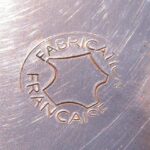
 A lot of French and European coppersmiths made copper cookware! Most of them aren’t around any more, but you can identify their pots and pans by their name stamped in the copper. Here’s how to get started with understanding stamps.
“Field guides” provide some history and examples of a few of the more well-known makers with some history and photographs of stamps. Look at the menu bar at the top of this page for a drop-down list.
There were (and still are!) also some smaller coppersmiths in the French village of Villedieu-les-Poêles in Normandy.
Some grand old department stores in Paris had custom lines of copper cookware at the turn of the 20th century. They didn’t make the pans themselves, but these pieces have a distinctive look. You can read about them here.
(And for a quick crash course in the eras of coppersmithing as I see them, please check out Antique vs vintage vs modern.)
Linings
 Copper pans for general cooking can be lined with tin, silver, stainless steel, nickel, or aluminum, and here’s some basic information about these options.
- Tin is my preferred lining.
- Silver-lined copper was offered starting in the early 19th century. Silver is electroplated onto copper in a very thin layer, and was generally considered for presentation pieces. Gentle care helps preserve a silver lining, but once damaged, it can be more costly to replace. Here are some tips to recognize silver.
- By the 1970s, manufacturers could bond nickel, aluminum, and stainless steel to copper. Aluminum-lined pans were produced in limited numbers and I have not yet featured aluminum-lined pieces on this site.
- I’ve compiled a post about Cupretam, Cuprinox, and Cupronil to discuss the tin-, steel-, and nickel-lined pieces during the 1980s-2000s era.
- Stainless-steel lined pans were made with three different interior finishes.
- It can be tricky to distinguish stainless-lined from nickel-lined pans, so here are some suggestions.
Buying copper online

I’ve bought all my copper pots and pans online and I’ve learned a lot in the process.
- My buying mistakes has some lessons learned.
- My Reference: Measurements, weight, and thickness tables can help you estimate the thickness of a copper pan by comparing it to others I’ve measured.
- Online sellers must pack pans carefully or they’ll arrive damaged. I have two posts on shipping boxes I have known — the good and the bad — plus a step-by-step unpacking of a very well-packed pan.
- You will have to decide whether the pan you’re buying needs retinning. Here’s how I decide whether to retin or not.
Basics
You may find these posts useful as you learn about copper and build your collection.
- How to tell a silver lining from tin
- How to tell nickel from stainless
- Interior finishes on stainless-lined pans
- Measuring copper thickness
- Rondeau, stewpot, soup pot, stockpot… how to tell the difference
My opinions
I’ve formed some opinions about specific brands of copper.
- Antique vs. vintage vs. modern
- Counting Mauviel’s rivets
- How I define collectibility
- How I evaluate quality and condition
- In praise of no-name copper
- Mauviel’s path forward
- My problems with Baumalu
- The demise of Mauviel’s cast iron handles
- The misleading “Gaillard Paris” stamp (updated)
All Buyer’s Guide posts
Alternatively, here are all the posts in the Buyer’s Guide category.