Martelage is the term I use for the all-over hammering on copper pans.
It’s a French word that simply means “hammering,” derived from martel, meaning hammer. I have borrowed this word to refer to a very specific type of hammering we see on French copper cookware: a regular pattern of shallow strikes that completely covers the external sidewalls and sometimes the base as well. This type of all-over hammering is applied after the pan has been shaped; the smith takes the pot and gives it extra hammering, by hand with a specialized flat-faced hammer or under the piston of an electric or pneumatic hammering machine.
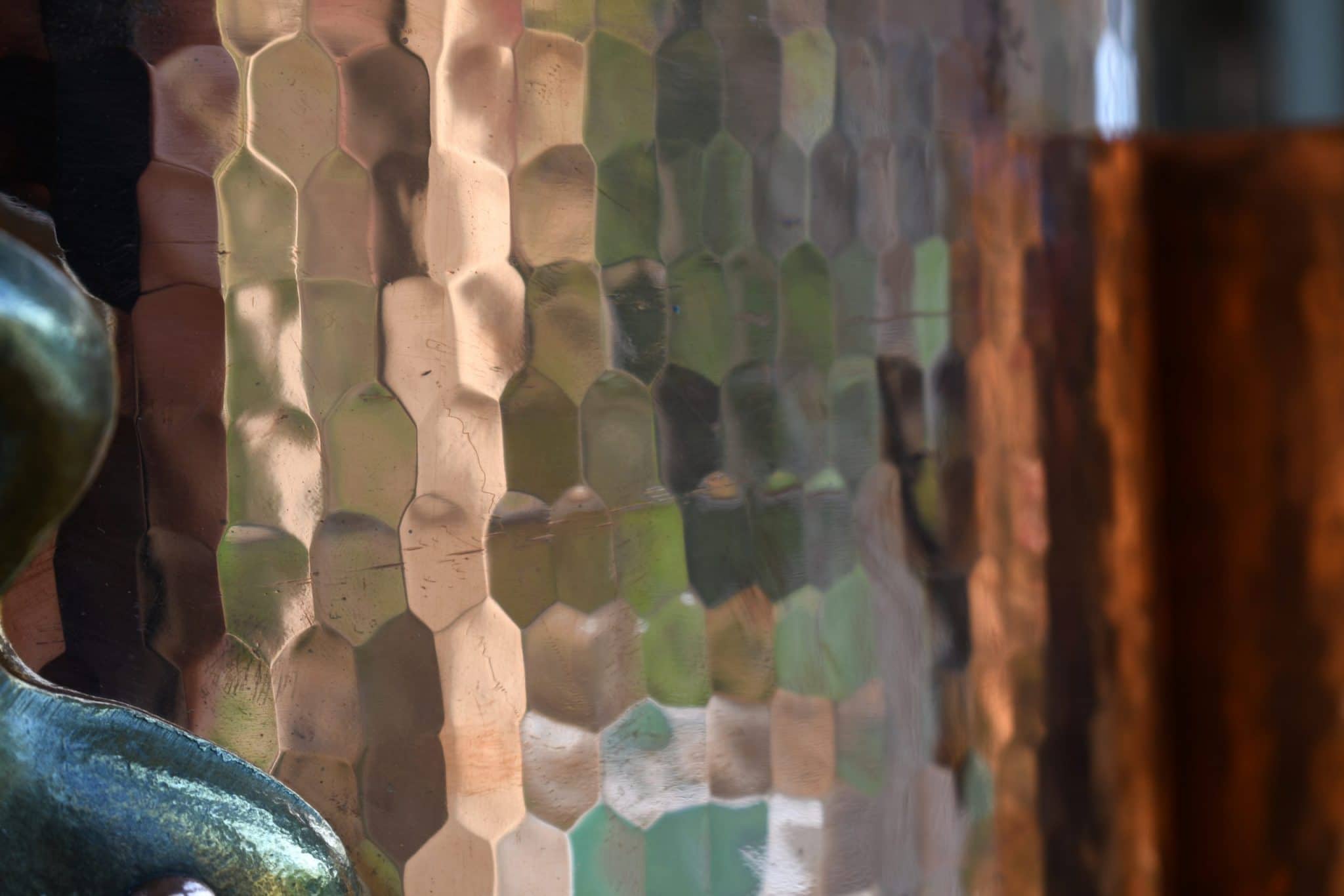
The purpose of martelage
Martelage is functional as well as decorative: it work hardens the copper on the outer surface of the pot, making it more resistant to deformation.
When pure copper is heated above its recrystallization temperature of 619°F (326°C) and then cooled, its atoms form grains arranged in a regular crystal lattice. Bend the copper, and defects called dislocations are generated in the lattice, and that’s what allows the metal to flow and stretch. Continue to deform the copper and the density of the dislocations increases to the point that their interactions interfere with each other and restrict further movement, making the copper harder and less ductile. This is work hardening: the copper has been worked — that is, bent or hammered — to the point that it resists further movement. Annealing the copper — re-heating it to re-crystallization temperature and then cooling it — lets the atoms reorganize into new grains and reduces the density of the dislocations, undoing the work hardening and restoring the copper’s malleability and ductility.
The principle of work hardening was well understood by 19th century coppersmiths. Paul Weiss, writing in Le cuivre for L’encyclopedie de chimie industrielle in 1894, describes how smiths applied multiple rounds of hammering to shape a copper piece, culminating in planage (leveling) to give the surface “regularity and stiffness”:
Hammering makes it possible to obtain the most varied curvatures, but determines a hardening, which is made to disappear by means of successive annealing. At the start of hammering, the workers use wooden mallets, so as not to immediately remove the malleability of the copper, and to avoid heating it too frequently; when the first shape has been given to the sheet, hammering is continued with the help of the iron hammer, taking care to bend the sheet over wood, to prevent the hammer blows from leaving too deep imprints, which it would be impossible to do away with later.
After hammering and bending, we proceed to planage, the purpose of which is to give regularity and stiffness to flat or curved surfaces. It is an important operation, on which depends the appearance of the copper which will present a beautiful polish and a regular surface, if the operation has been carried out well.
The French term planage, from the Latin term planus (flat or level), is the origin of the English term planishing. The purpose of planishing is to create a flat plane on the surface of the copper, but John Fuller described a more utilitarian objective in his 1893 book Art of Coppersmithing:
Another style of planishing is executed in a way that every blow may be seen distinctly and in regular succession, and is adopted in that kind of goods where closing the grain or hardening is the principal object in view, as in washing coppers and some other work; while for many rough kinds of braziery, such as carboys, sugar molds, pump heads, air vessels and various kinds of boilers, the hammering is done in a promiscuous way, so long as the surface is covered and the work hardened sufficient to maintain its shape.
The key term to which I wish to draw your attention is “rough braziery.” Note the examples that Fuller lists: a carboy, a container for a liquid; a sugar mold, a funnel to solidify syrup while the molasses dripped away; a pump head, a long tube with a spout and lever to draw water up from a well or container; and air vessels and sundry boilers. What all these things have in common is that they are all simple cylinders, tubes, or funnels that could be made by bending a copper sheet to the desired diameter — that is, without significant hammering. For these pieces, the copper did not undergo all-over percussive hammer strikes during the shaping process, and without that hardening, it was vulnerable to dents and deformation. And so the smith added an extra step to “close the grain” — creating dislocations within the copper to lock the atoms into position and make the finished piece more resilient.
What I conclude from Weiss and Fuller is this: a working copper object needed hammering to give it a requisite toughness. It was enough simply to hammer it all over “in a promiscuous way” — I love that mental image! — “so long as the surface is covered,” though a skilled smith would seek that “every blow may be seen distinctly and in regular succession.” That, my friends, is martelage.
The evolution of martelage on antique French copper
Reader, a question: How does one make a copper pot without hammering?
The answer, of course, is to press or spin it into shape. Pressing (or deep drawing) uses a powerful punch to force a flat “blank” of round metal around a die. Spinning (or turning) mounts the blank onto a lathe, spins it at high speed, and applies a workpiece to force the metal against a mandrel or block. In both of these processes, the metal must flow into its new shape; if the pressure on the metal confers any minor work-hardening, the smith may need to shape it over a series of steps interspersed with annealing to restore the metal’s ductility. At the end of these processes, the finished piece has experienced very little work hardening.


My hypothesis is that when the French chaudronneries adopted powered presses and lathes towards the end of the 19th century, they saw that copper pots and pans formed by these non-percussive processes were too soft and malleable for professional kitchen use, and so they added the extra step of martelage to harden the pieces for use. (Martelage is not unique to France or to French cookware, of course, but for this post I will be discussing it in this context.)
Based on my own collection and observation of copper on online sites, I begin to see martelage on French pieces at around 1885, around the same time that I begin to see heavier restaurant-grade copper pots and pans at 3mm, 4mm, even 5mm thickness. I believe these two phenomena are connected: the burgeoning restaurants in Paris needed thicker copper cookware for heavy use, which in turn required thicker sheet metal that could only be shaped with powered presses and lathes, which produced finished pieces that, despite their thickness, had experienced no work hardening and were therefore vulnerable to deformation. These pieces needed toughening up: A restaurant chef expected his batterie de cuisine en cuivre to survive heavy use (and abuse) and multiple cycles of cleaning, retinning, and repair. Martelage was a necessary process to prepare a pan for restaurant-level service.
I am spending so much time on this topic because I believe martelage is one of the factors that can help you differentiate the era and grade of French copper cookware by sight. From the 19th century to the late 20th, a French copper pot with martelage is very likely an extra-fort (extra thick) piece intended for cooking; a smooth-sided piece is very likely a sur table (on the table, or table service) piece intended not for cooking but instead for presenting cooked food at the table. (Are their exceptions? Of course, and I will discuss them later in this post.) Martelage is one of multiple indicators of grade for tinned French copper cookware, but my experience has been that every time I see it, it’s on an extra-fort piece.
Examples
I’ve compiled a series of example pieces in rough chronological order (based on my own amateur assessment) to show you examples of what I’ve discussed above.
Before martelage
Unknown maker, 1845
This 16cm bain marie was made for the royal household of Louis Philippe at the château de Fontainebleau and is helpfully stamped with the year 1845.


This little pot is completely hand-made, down to its wrought iron handle. This piece was made for the King of France — it would have represented the absolute pinnacle of coppercraft for its time. In this era, a smooth surface was the ultimate expression of a smith’s skill.
Personne, 1843 to 1870
This 28cm sauté carries a stamp for Personne, founded in 1843 and purchased by Lagaldie in 1870. It’s just gorgeous.


At 1.8mm thickness, this pan was made from 2mm thick sheet — a restaurant-grade piece for its time. The copper has a consistent texture across the base and sidewalls, which suggests to me that the pan was hammered into shape and then smoothed with a round of planishing. This is another lovely example of a piece with planage that is not martelage: the copper experienced sufficient work hardening as part of the shaping process, and so the final round of planishing was to smooth the surface. It’s beautiful work. Lagaldie was subsequently purchased by Eugène de Hillerin in 1885 as the foundation for his eponymous chaudronnerie, and Dehillerin advertisements as late as 1905 still mentioned the firm’s lineage back to Personne 70 years prior. Looking at this lovely piece, I can understand why!
Hand-hammered martelage
I begin to see pieces with martelage appearing circa 1880 to 1890 in my collection and from my survey of online listings, corresponding to the emergence of machinery to press and spin thicker copper. The pans below represent early pressed or spun pieces that received additional finishing.
Dehillerin, 1885-1890
I can place this 23cm sauteuse évasée (or Windsor) between 1885 when Eugène de Hillerin had started his chaudronnerie and 1890 when he opened his well-known store in 1890 on Rue Coquillière. This would be Eugène’s work at the very start of his career before he became the proprietor of what would become the most famous French kitchen store in the world.
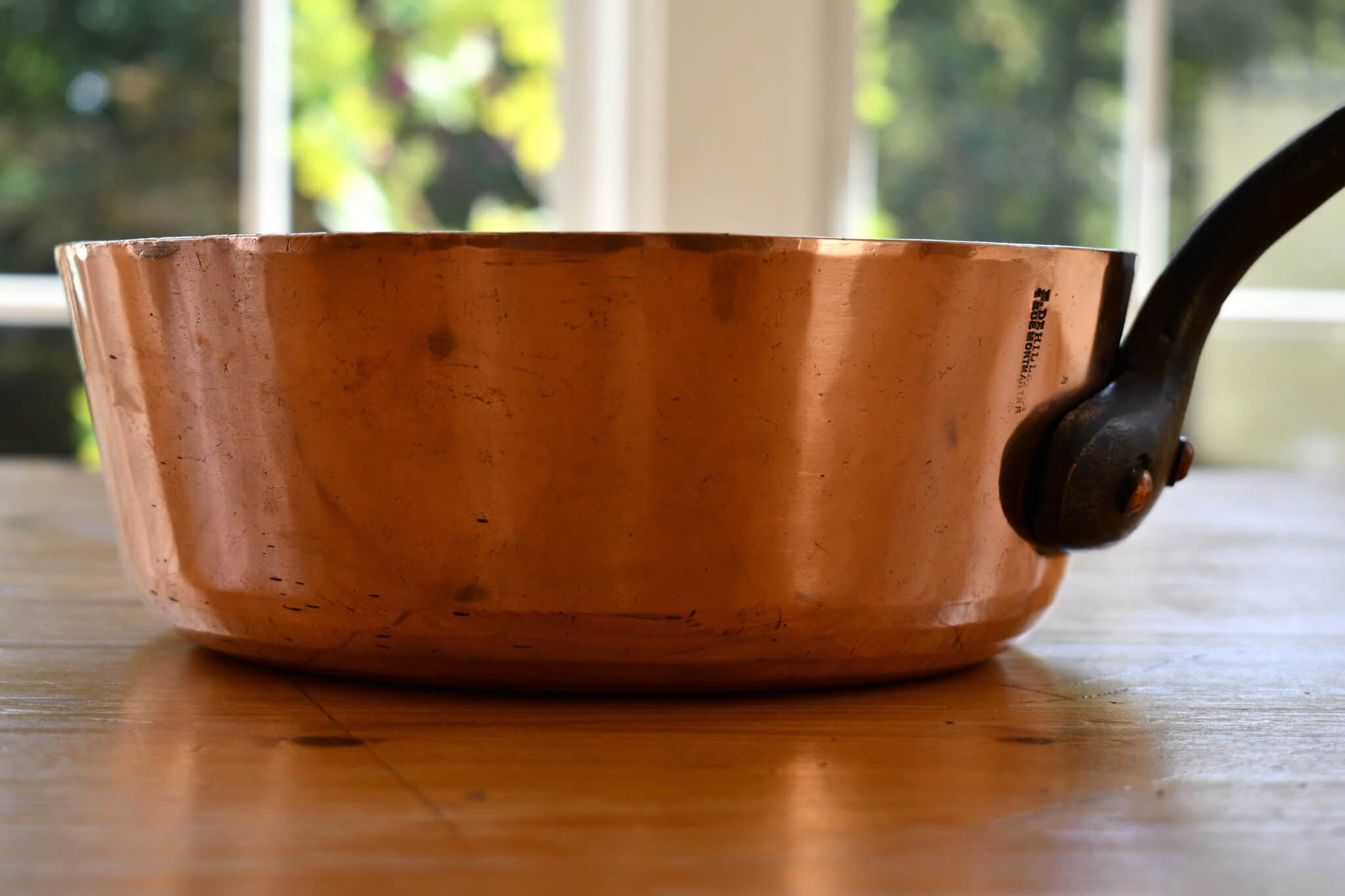
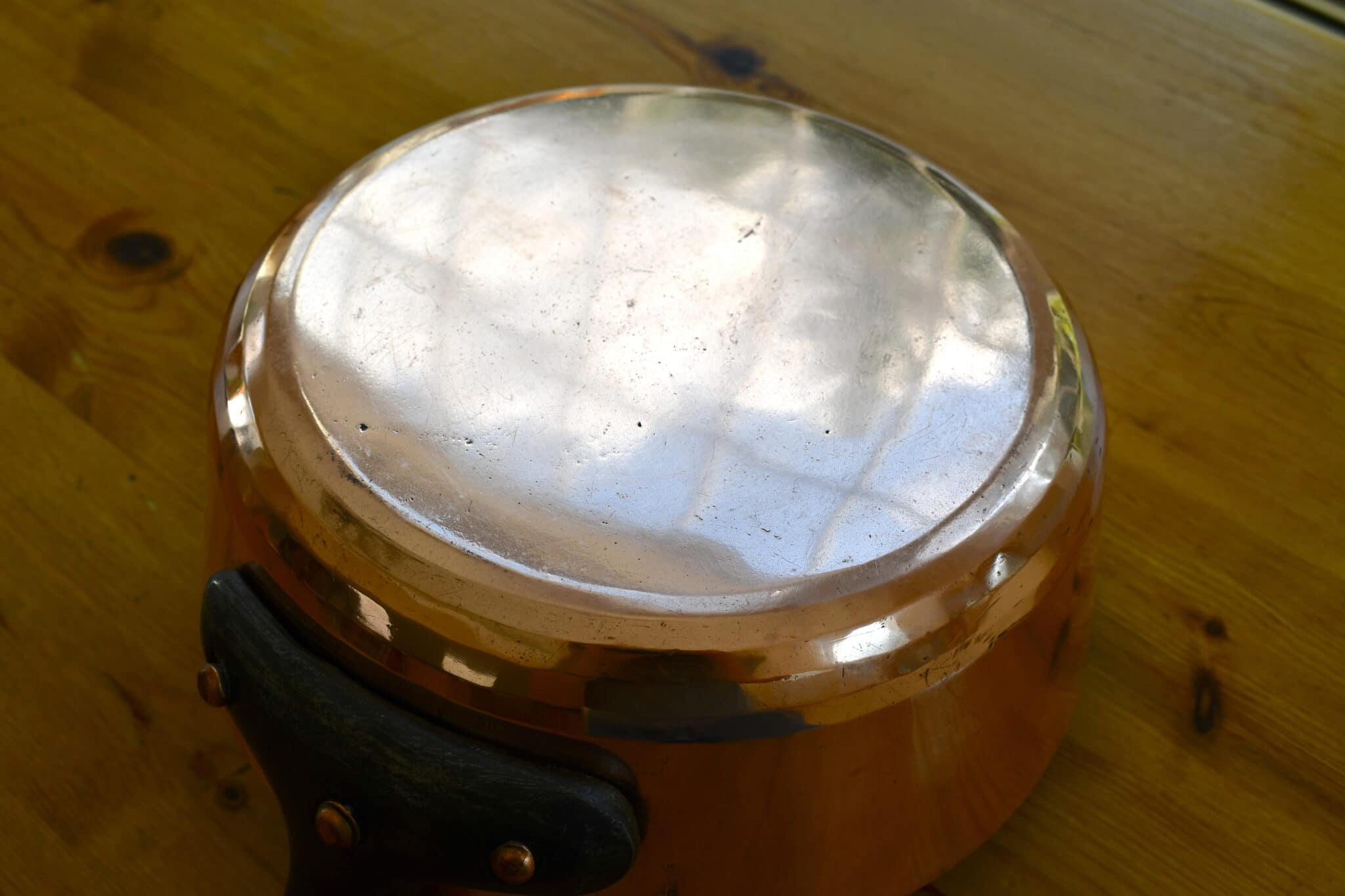
This piece was made during the transitional period in the late 19th century when some chaudronneries began to adopt machine presses while others continued to shape pieces by hand. The smooth base of this pan indicates that it was pressed. (Compare its mirror finish to the gently rippled base of the Personne sauté just above.) This piece would have had to have been machine-shaped: its weight indicates that it was formed from sheet stock at least 3mm thick. (It is that quantum leap from 2mm stock to 3mm stock — and thicker — that marks the adoption of powered machinery.) The martelage is evenly distributed across the surface and the return (the sharp curve between base and sidewall) has five beveled planes. This is a very high quality piece.
Gaillard and Dehillerin, 1890-1900
I believe these two pans are contemporaries from around 1890-1900. While these photos are not optimal to show martelage (I am reusing photos from prior posts throughout this post, so sorry about that), I can still see enough detail to notice differences.

The hammer strikes on the 27cm Gaillard on the left (3.8mm thickness) look larger than those of the Dehillerin on the right (4mm plus), but after careful study I believe this is due to a difference in spacing. The Gaillard strikes are laid down just slightly further apart than the Dehillerin strikes. I suspect this was intentional, as we will see this again.
Lasnier, 1900?-1907
I include this piece as an example of the work of Lasnier, a lesser-known chaudronnier in Paris. Lasnier was in business from 1887 to 1907, when it was acquired by Dehillerin; I estimate this pan was made towards the later end of that range, circa 1900 to 1907. The martelage is very fine with even and closely-spaced strikes. I think this pan is absolutely beautiful and every time I see it I am reminded of how much I love it.
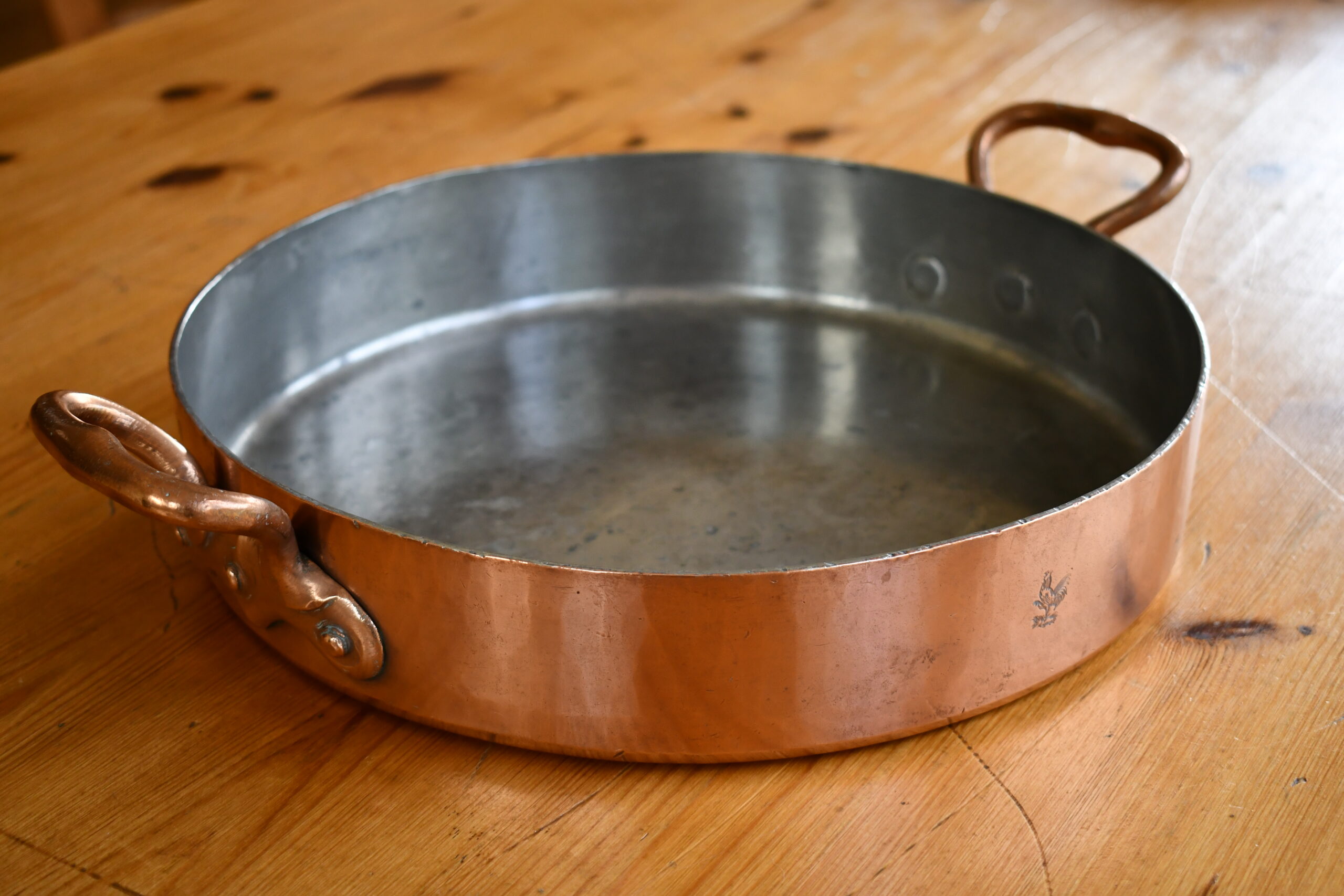
J. & E. Gaillard, 1903-1919
The strikes of the martelage on this enormous 4mm thick 36cm saucepan exhibit an oblong shape. I think this is again due to the spacing of the hammer strikes, similar to what we saw on the earlier Gaillard sauté above.


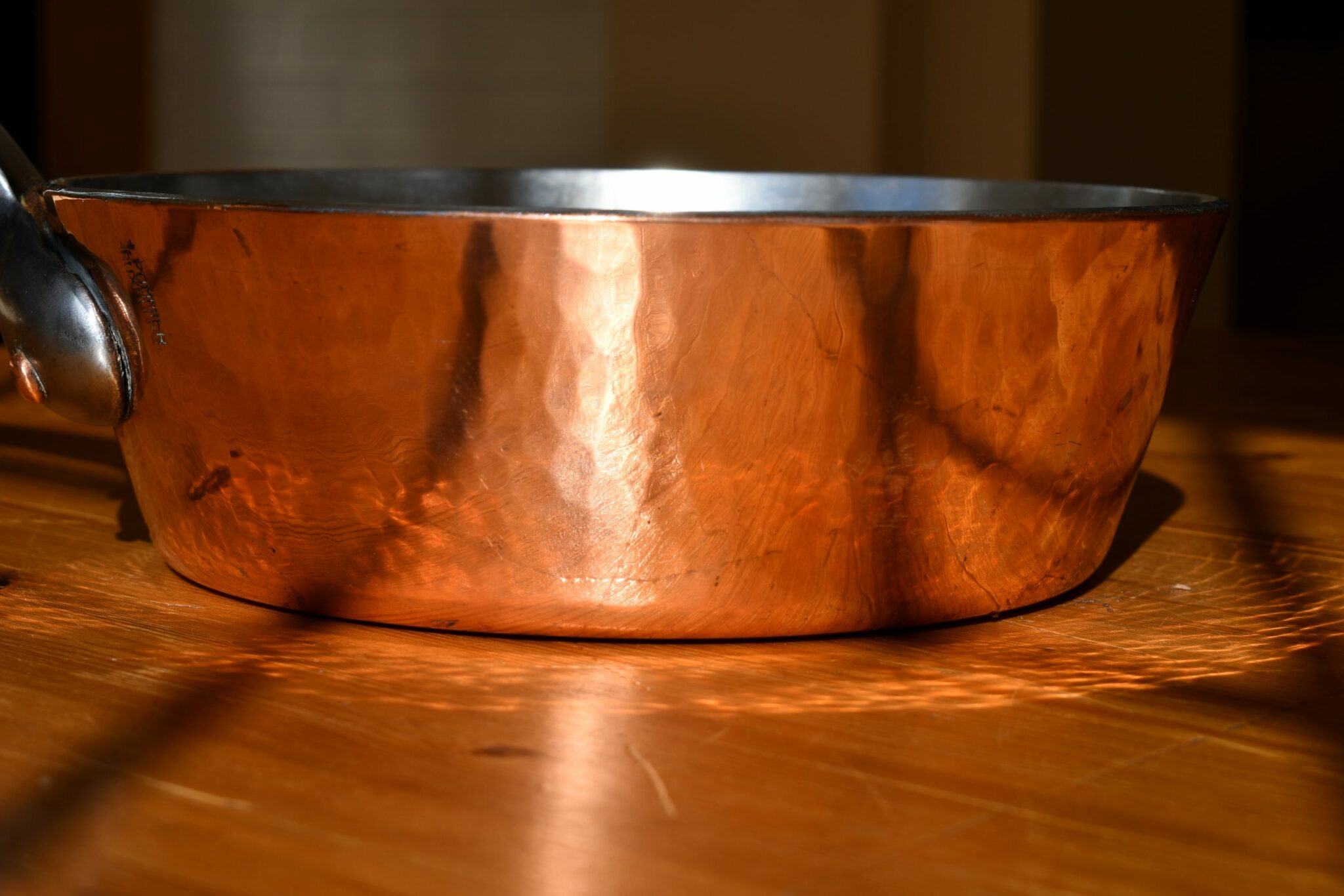
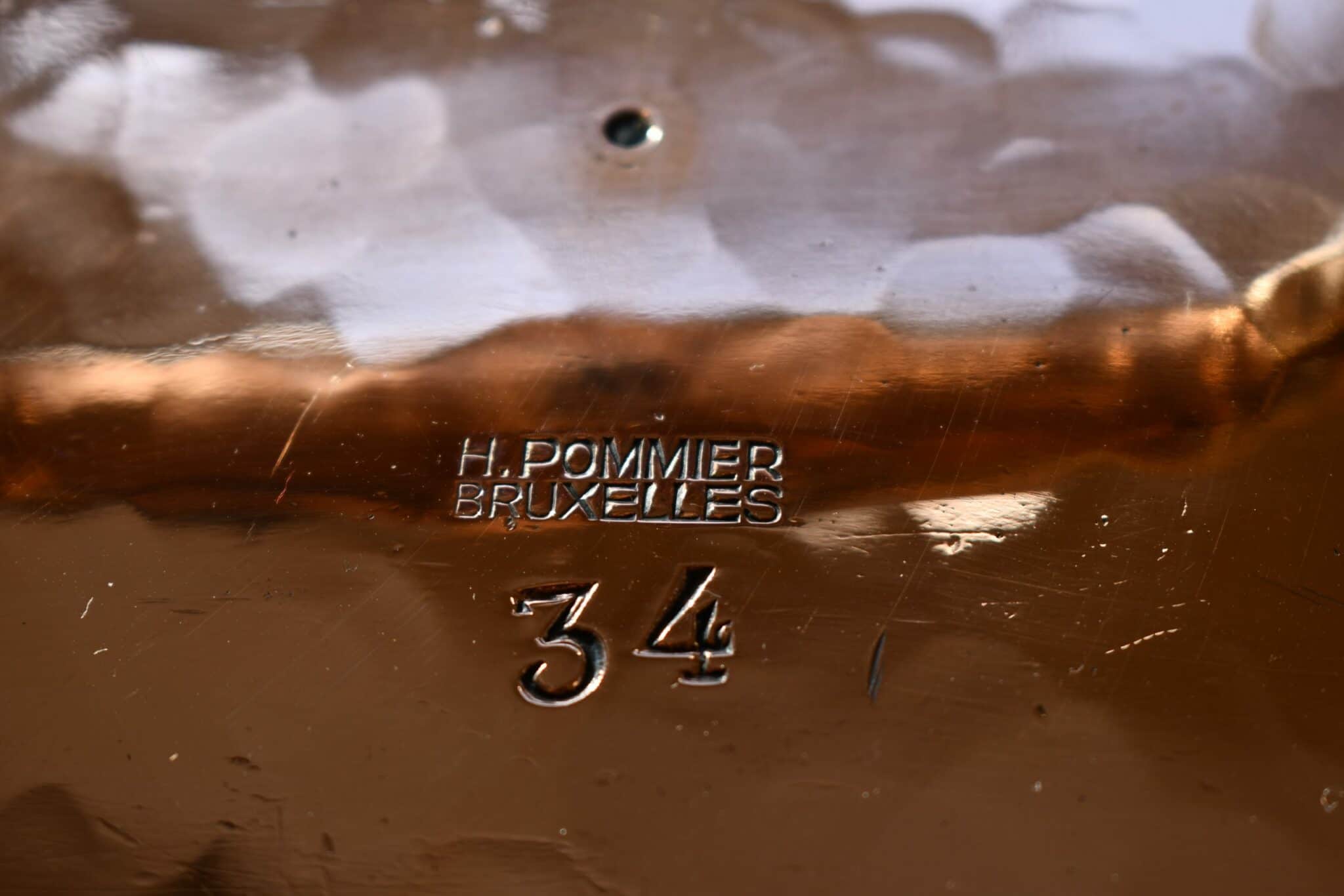
Pommier, 1910-1920
The scattered reflection of light onto the tabletop shows the random (yet even) distribution of strikes characteristic of hand-applied martelage on this 24cm évasée.

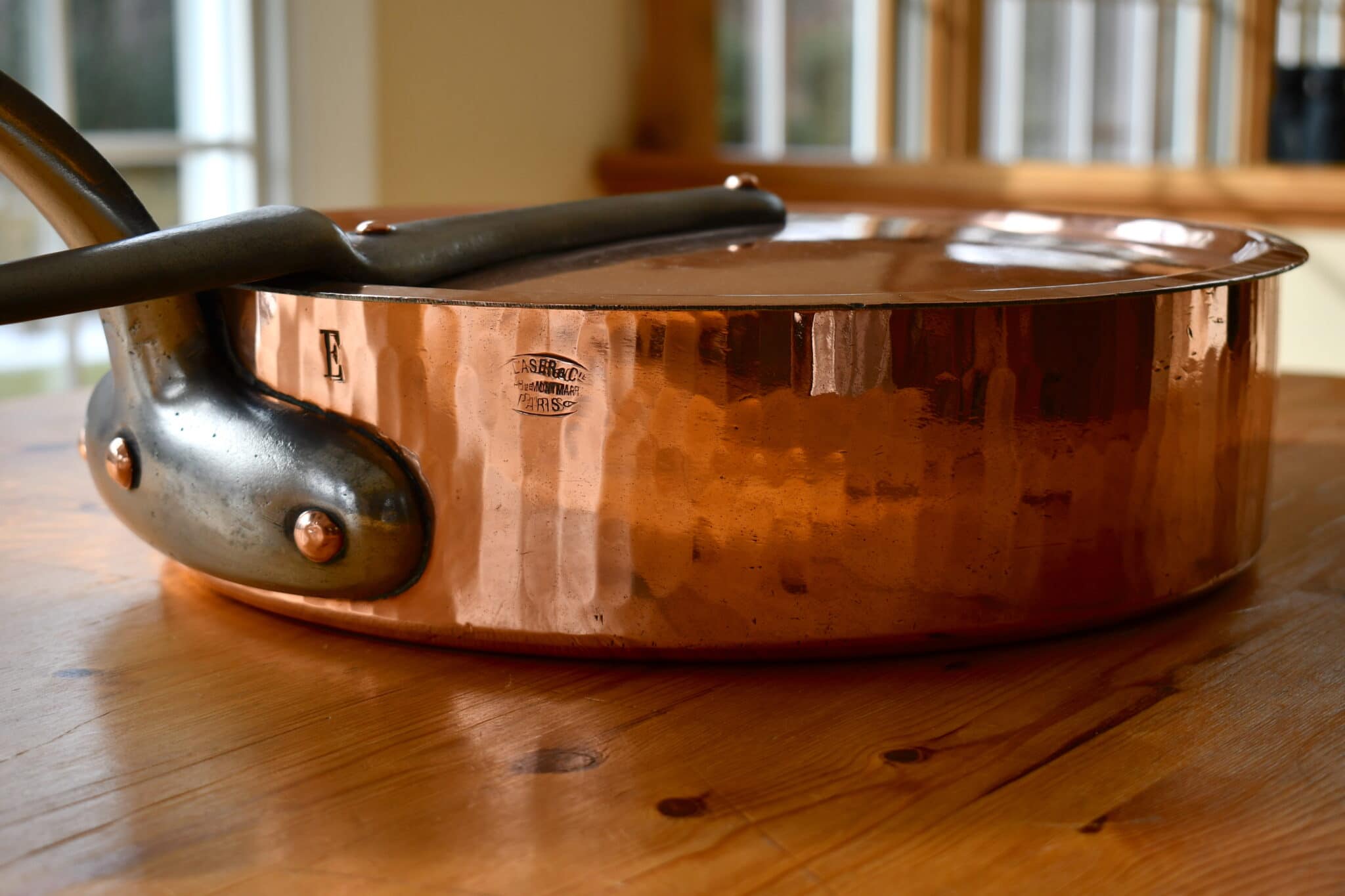
Gaillard?, 1928-1935
This 34cm sauté does not have a maker’s mark, but the Blaser & Cie store stamp dates it to between 1928 and 1935. The hammer strikes are narrowly spaced horizontally, but the rows are slightly more widely spaced, producing a pronounced oblong hexagonal shape. (I will call this “tall spacing.”) I have seen this same pattern on Gaillard pieces and I tentatively attribute this piece to Gaillard as well.
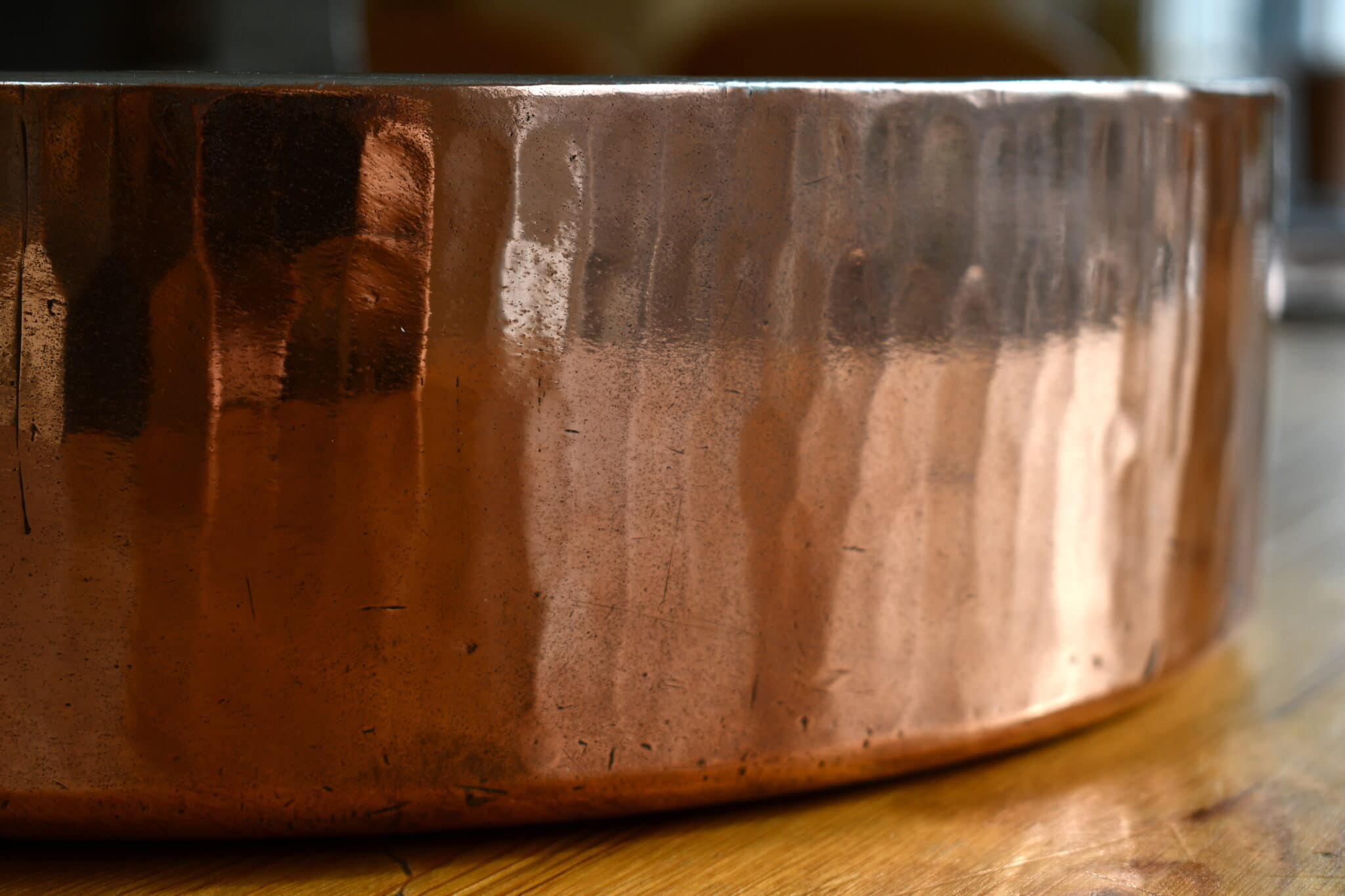
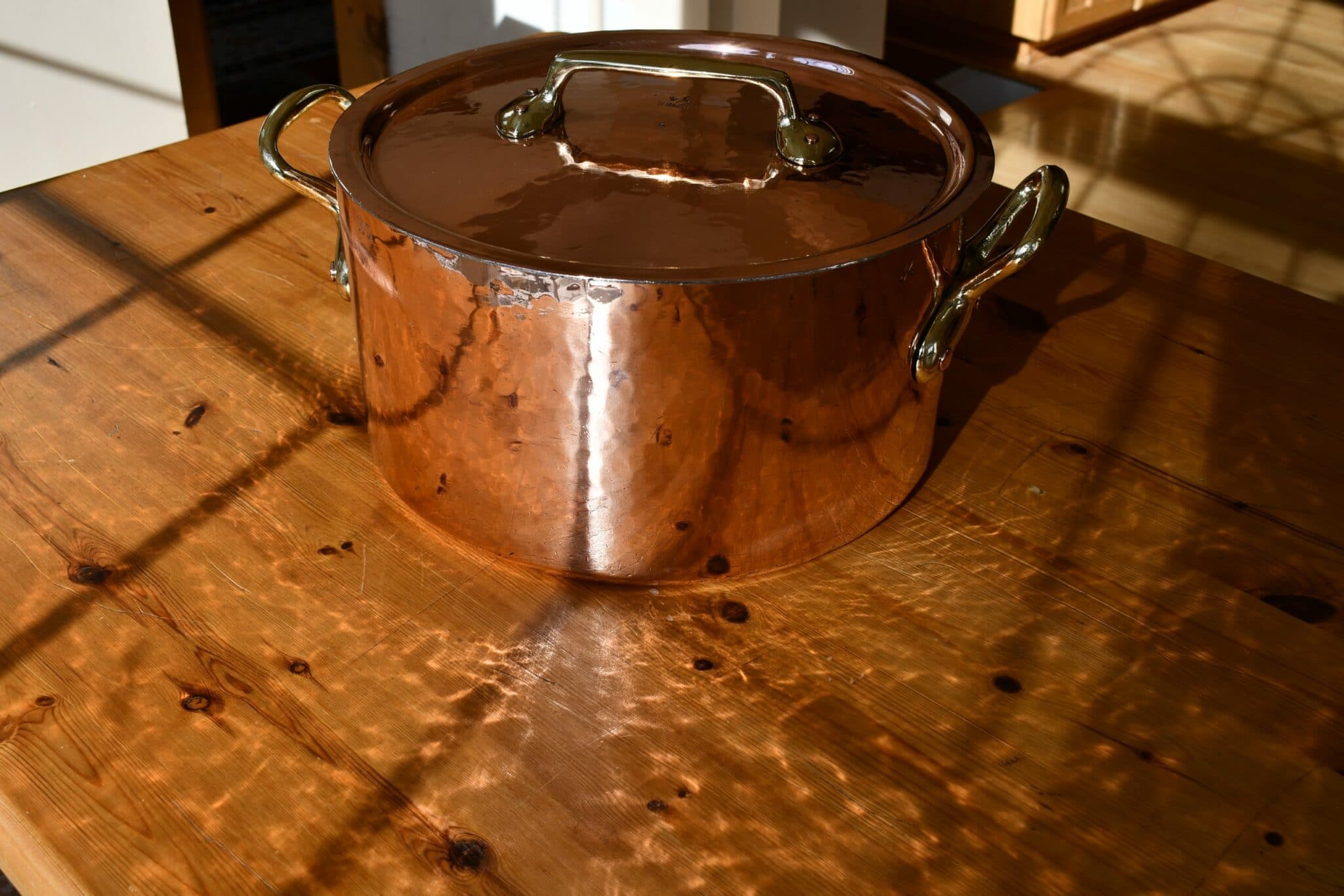
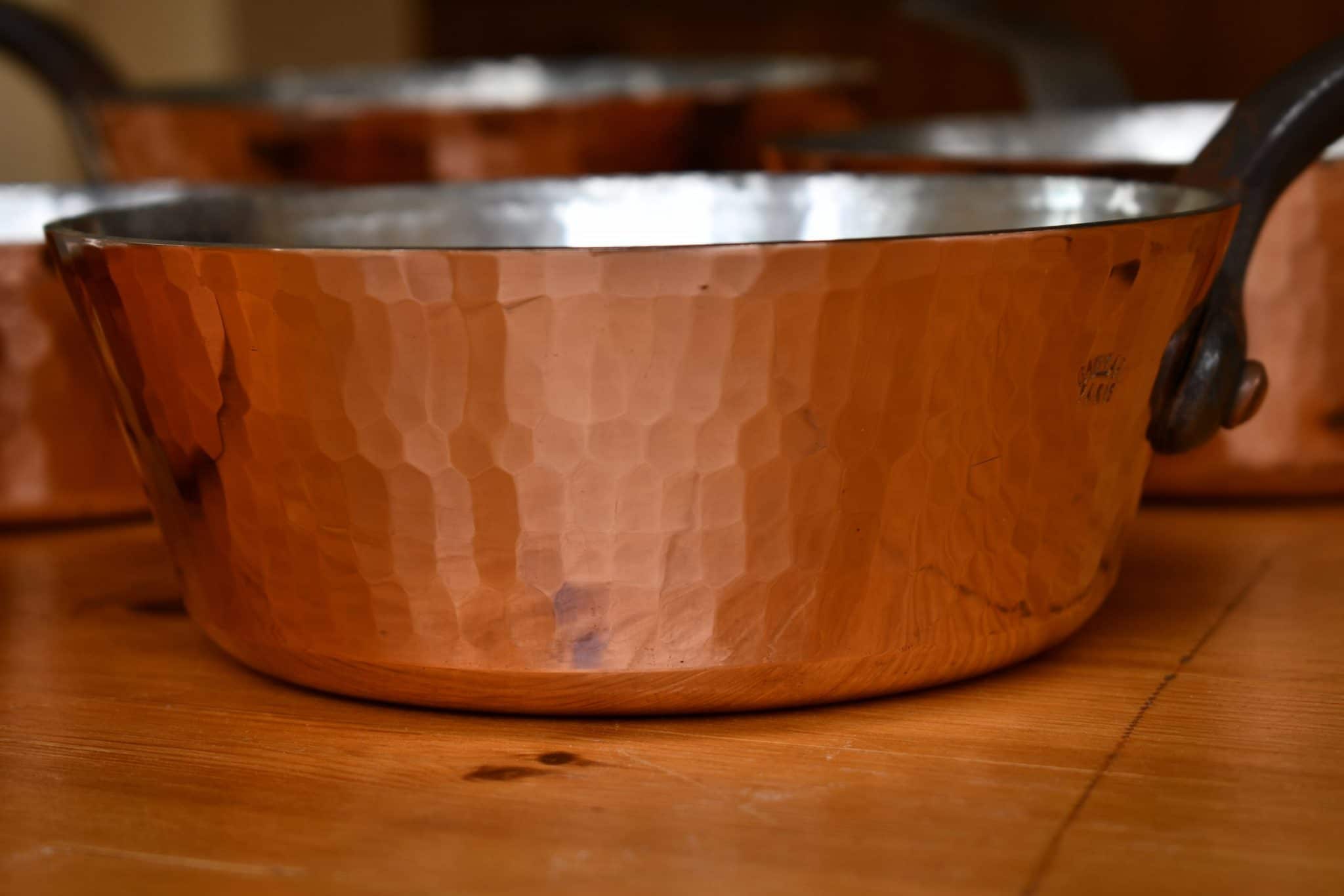
Pommier, 1920s-1940s
The martelage on this 34cm stewpot has lost its crisp edges but the round strike shape can still be seen on the lid. The reflected pattern shows the scattered pattern of hand-hammering.
Machine-hammered martelage
 During the 1930s to 1940s, the technique of martelage was transformed by the widespread adoption of the powered piston hammer. For this process, the smith mounts the pot onto a support die and a machine drives a piston onto the copper surface, as shown in the photo at right. The smith can control the interval and force of the piston and is responsible for shifting the pan to lay down the strikes. Not every French coppersmith adopted the piston hammer; smaller coppersmiths in Villedieu, such as Atelier du Cuivre, press or spin their own pieces (or purchase them from a supplier) and continue to this day to hammer them by hand. (The photo at right is from David Lebowitz’s excellent article from 2017 on his visit to the Mauviel factory in Villedieu.)
Mechanized planishing would have sped up the martelage process dramatically while relieving the smith of much of the physical strain of hammering by hand. And whereas a smith with a hammer had to judge the location, angle, and force of every one of his strikes so as to avoid the dreaded “half-moon” imprint of a mis-placed blow, the piston ensured a consistent force and angle over the entire pot.
The regularity of mechanical martelage also creates distinctive visual artifacts that can help you recognize it. Some of these artifacts are inevitable consequences of the process, while others could be considered cosmetic defects in the martelage. I emphasize, of course, that “defective” martelage has no effect on the function of the pot and is purely aesthetic. But for our purposes, defects in the martelage are a reflection of the tradecraft of the chaudronnier at the time and can indicate a rushed process or an inexperienced smith.
Jacquotot, 1922-1939
This 40cm oval gratin is up first. Jacquotot made this piece prior to 1939 when the firm moved from Rue de Grenelle to Rue Damesme. The martelage looks mechanical to me, and quite expertly done: each strike is narrow and evenly spaced, and each row is interleaved with its neighbors to produce a nice consistent look.


 I draw your attention to the return, the corner where the base of the pan meets the sidewall. In pressed or spun piece, the outside surface of the return is initially a smooth curve; the smith may bevel this surface to work-harden it, but often the return is left untouched.
In the photo at right, the bottom row of martelage is applied right at the return. This is very cleanly done — the bottom edge of the first row of hammering meets the return perfectly. Keep this treatment in mind as we look at later pots.
Mauviel, 1940s-1960s
This 32cm stewpot has lovely mechanical martelage. The strikes are closely-spaced symmetrical hexagons and most of the rows are nicely interleaved… but not all of them.


A smith operating a piston hammer begins at the base of the pot and lays down one row at a time, shifting the pot after each row is completed to start a new row just above, and working methodically row upon row up to the rim. A skillful smith can position the pot such that the strikes overlap and the rows interleave to produce a honeycomb effect, which is the ideal arrangement for martelage. (The close-up photo above right shows the honeycomb look.) There are relatively few rows on pans with short sidewalls, but taller pans — stewpots and stockpots — have many more rows, and it is on these pans that the alignment of the strikes in successive rows tends to drift. Row upon row, tiny variations in spacing between strikes accumulate to shift the alignment of the entire row so that it appears stacked on the row below.
In the photo above on the left, look towards the lower left quadrant of the pot and you will see that strikes in some of the rows are vertically aligned. I have yet to see a stewpot or stockpot with no stacking over the entire surface and I suspect it would be very difficult to achieve this perfection. But you would never see this on a piece with hand-hammered martelage, and so stacked rows are a clear indicator of mechanically-hammered martelage.
Mauviel?, 1960s-1980s?
This pan has astonishingly distinct martelage due to some fortuitous tarnishing, and so we can see very clearly where the strikes are placed and how they are aligned. I am fairly certain this pan is Mauviel, but I fear it is not the best example of their work.


The first issue I see is that the lowest row of martelage is placed quite high above the return. On the Jacquotot gratin shown earlier in the post, the martelage begins right at the return, whereas on this sauté there is a gap of a few millimeters. The second issue that I see is that many of the strikes do not overlap each other and look like dots surrounded by empty space.
I think this is evidence of rushed work. There are simply too few strikes on this pan to cover the entire surface. This raises the question of whether Mauviel was been cutting some corners to keep up with aggressive production targets in the post-WWII era. Again I emphasize that the pan’s performance is unaffected, of course, but I would expect better finishing from Mauviel.
Gaillard?, 1940s-1960s
After WWII when copper was scarce, the French makers substituted aluminum in their copper production lines instead, to produce pieces like the aluminum saucepan below that is a lookalike for copper. I see oblong hexagons that I continue to think are a consequence of what I call tall spacing. This is the second pan I’m showing you with this pattern, and while this is not a huge sample size, I think this might be a characteristic of Gaillard.


One thing to keep in mind is that the martelage on aluminum pots is doing some good, but the best way to make an aluminum pot more resilient is to make it really thick — 4mm thick or more. Aluminum is a softer metal than copper and an aluminum pot is more likely to deform than a copper pot of the same thickness. Adding martelage to an aluminum pot will give it some protection but is more likely an aesthetic choice to mask cosmetic flaws in the soft metal.
Jacquotot, 1940-1974
These two pieces — a saucepan and a 40cm sauté — have the same Jacquotot stamp for production from 1940 or so until 1974, but I am showing both of them to you to illustrate different qualities in their martelage.
This is an absolutely gorgeous saucepan with martelage that has the dense and pleasingly random look of hand-hammering. However, towards the midline of the sidewall, a few rows have drifted into vertical alignment. This is a dead giveaway of machine martelage, but to my eye, it adds to the appeal of the piece. The stacked rows create a textured, almost dimensional visual effect that I find interesting and beautiful.


The sauté below is an absolutely magnificent piece at 40cm diameter and 3.2mm thickness. Like Mauviel, Jacquotot was also hustling to fulfill burgeoning demand in the post-WWII era, and I see some signs of haste in its martelage. Take a close look and then I will tell you what I see.


Firstly, the martelage has a pronounced oblong shape and it looks to me that there are no more than three or four rows. (I would call this extreme tall spacing.) Secondly, the sidewalls show some spin marks — parallel horizontal lines visible between the hammer strikes. The martelage should have been applied to cover the marks completely, but it appears that the smith laid down just a few rows of widely-spaced strikes. Again, this is only cosmetic, but it tells us that the smith could have spent a little more time on this piece to cover the spin marks completely.
Mauviel?, 1960s-1980s
This is one of a set of windsors with a late-stage Gaillard stamp that I suspect was instead supplied by Mauviel. The martelage is fairly well done but shows a few cosmetic flaws: The martelage is a little high above the return, and the pattern of strikes is uneven and doesn’t quite conceal some spinning marks.

Mauviel?, 1960s-1975
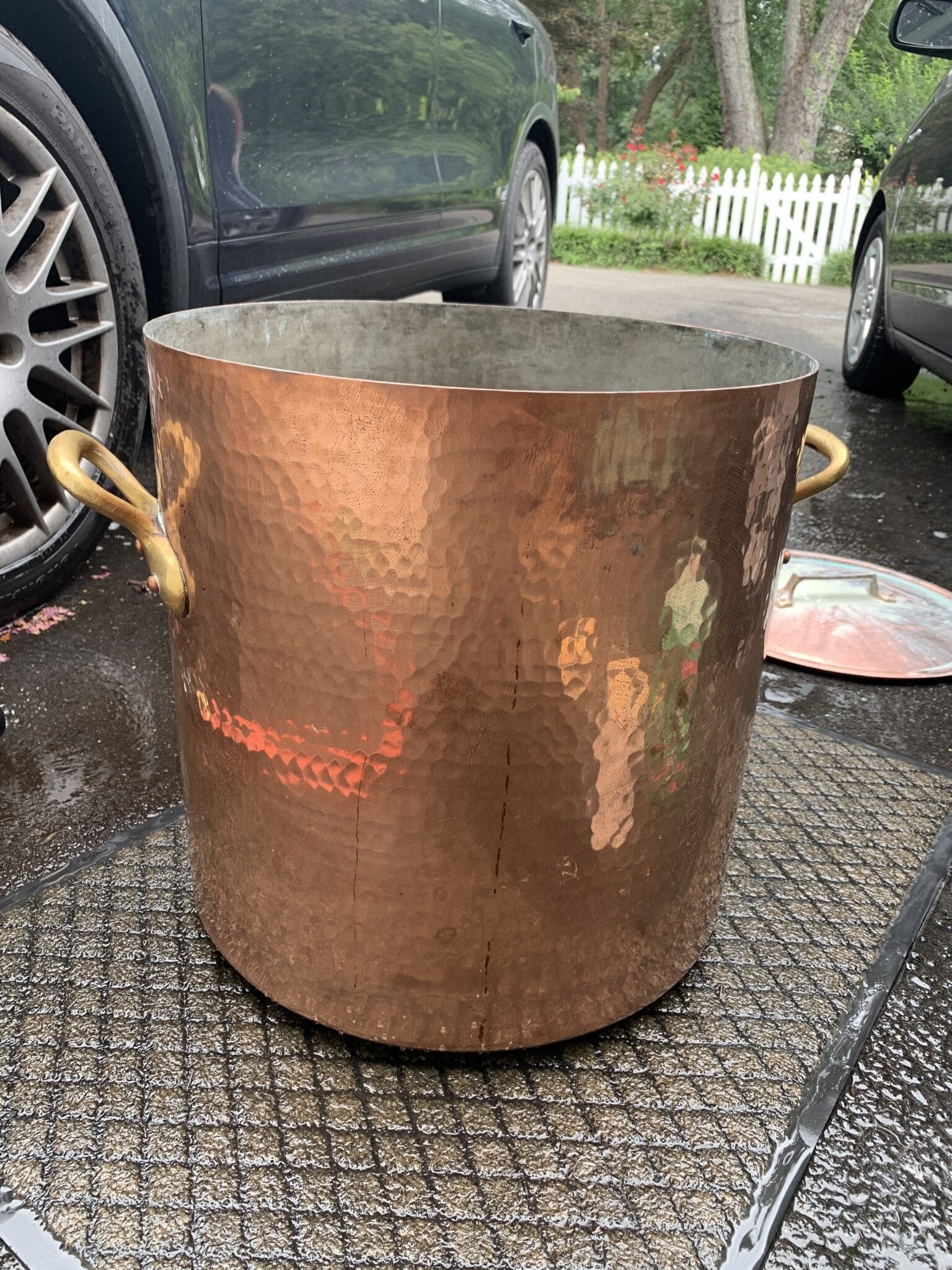
The tarnish on this stockpot shows the martelage very clearly. (It’s a gorgeous effect that reminds me of the spots on a leopard.) The pot has a Lamalle stamp and “Made in France,” which suggests to me that it’s Mauviel from the 1960s until 1975 when the Lamalle store closed. Note how the shape of the strikes varies from round to oblong across different rows — this is a huge piece and it would not surprise me that the smith’s spacing shifted a bit over the process.


Mauviel, 1960s-1985
This 44cm stockpot is cousin to the stockpot just above, but the martelage is the most consistent I have seen on a pot this big. The rows are all interleaved and I don’t see any obvious vertical alignments. This is a Mauviel pot with a generic Villedieu France stamp from pre-1985.
Mauviel, 1970s to 2007
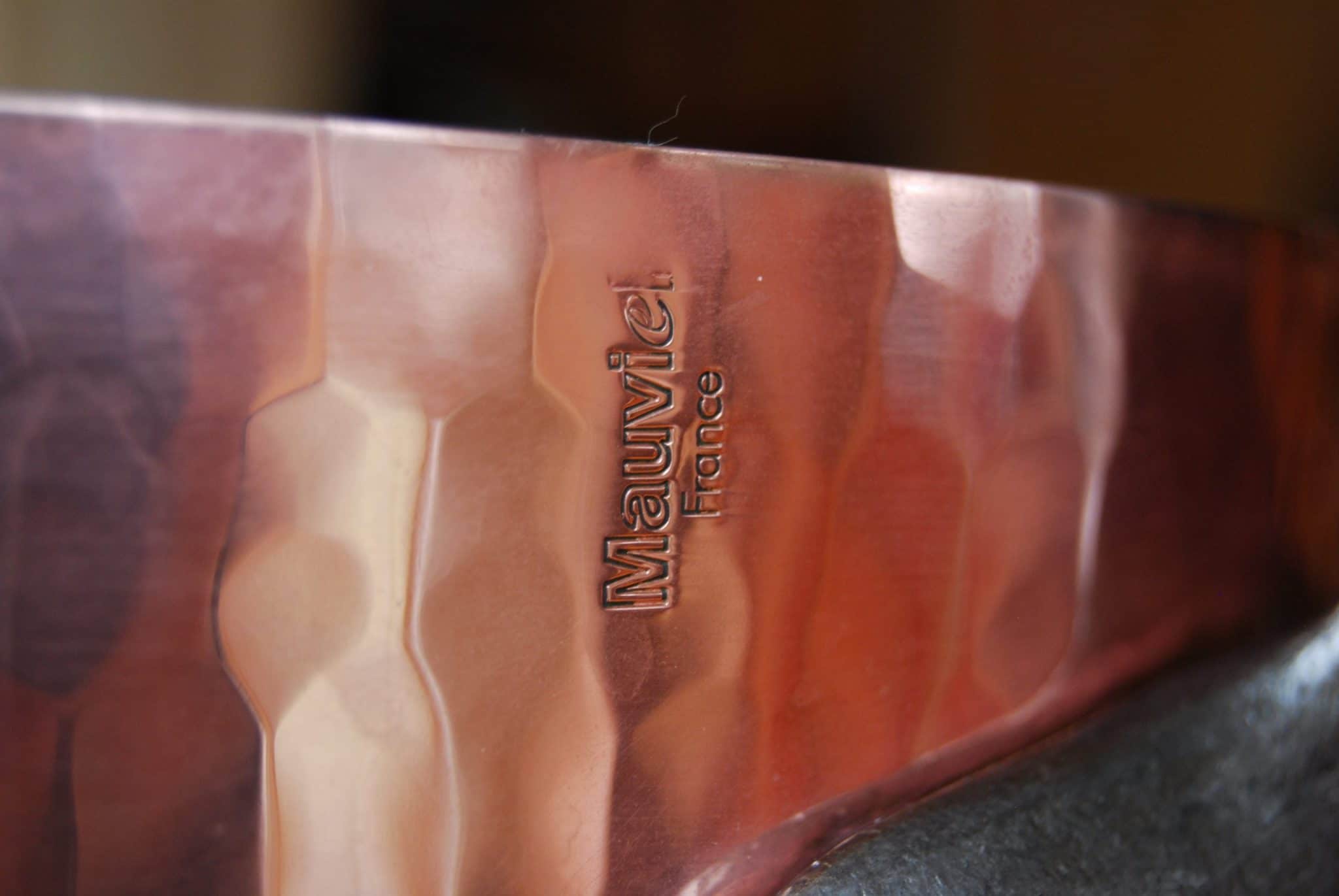
This 30cm sauté is one of many thousands that Williams-Sonoma imported from Mauviel for the US market from the 1970s to the early 2000s. The reflected pattern shows the regular arrangement of machine-hammered martelage with the same round strike shape that I believe is characteristic of Mauviel.


Mauviel, 1985 to 2010s?
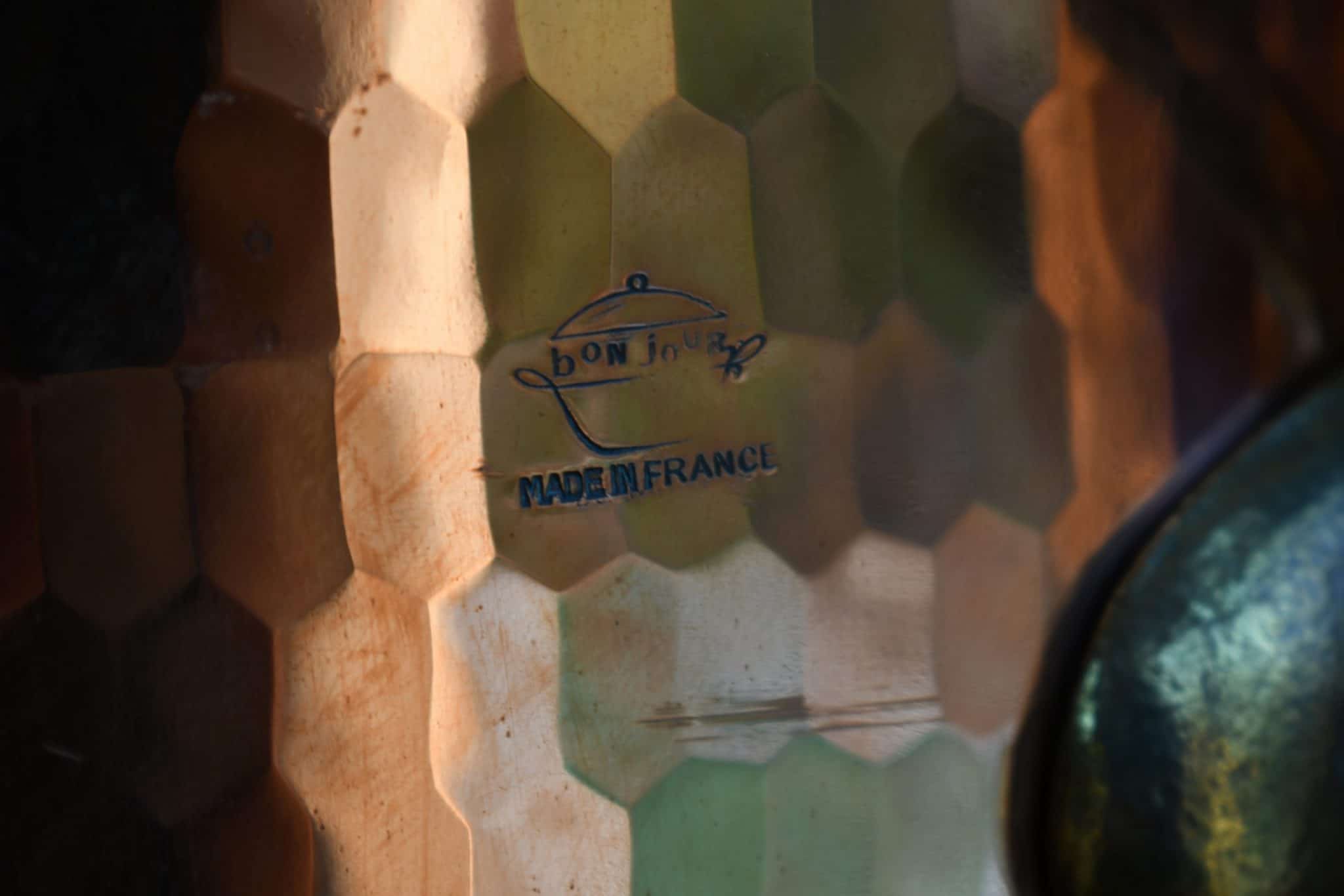
The style of martelage on this 24cm saucepan is likely unchanged from the 1980s until the 2010s. The round strikes are closely spaced and nicely interleaved.

Summary and comparison table
| Hand-hammered martelage | Machine-hammered martelage |
|---|---|
|
|


The exceptions
Why aren’t all copper pieces given martelage? I can think of several reasons.
Not all pieces functionally need work-hardening. For example, copper pots and pans made at lighter thickness (less than 2mm) as “table service grade” intended for a beautiful presentation of cooked food. These pieces were never meant to be used on the cooktop and so did not need work-hardening against dings and dents. Similarly, very small saucepans used to melt butter or other light duties would not need this kind of armoring.
Not all pieces need structural reinforcement. Copper-steel bimetal pans are the best example of this: the stainless steel lining provides all the dent resistance the pan could ever need. I also have yet to see a hammered nickel- or aluminum-lined piece, and I think it’s the same case for those.
Some consumers prefer the smooth look. My read of John Fuller’s book and my observations of antique English copper leads me to believe that the smooth look was the preferred aesthetic for high-quality English copper in the 19th and early 20th century. In the Fuller quote above, he notes that martelage was used on industrial pieces and heavy-duty “washing coppers”; elsewhere in the book he discusses the protracted cycles of planishing on finished pieces to make them smooth. Some modern-era consumers might agree: Towards the 1970s to 1990s, Mauviel’s U.S. reseller Bridge Kitchenware in New York City special-ordered thick copper from Mauviel with no martelage for American customers who wanted high-quality copper but preferred the smooth look. (Here’s one example.)
Some pieces were already work-hardened during the shaping process. As I discuss above in some detail, the need for martelage depends on how the copper was shaped. A copper piece shaped by impact forces — that is, cycles of hammering and annealing in order to attain its final form — was already work-hardened.
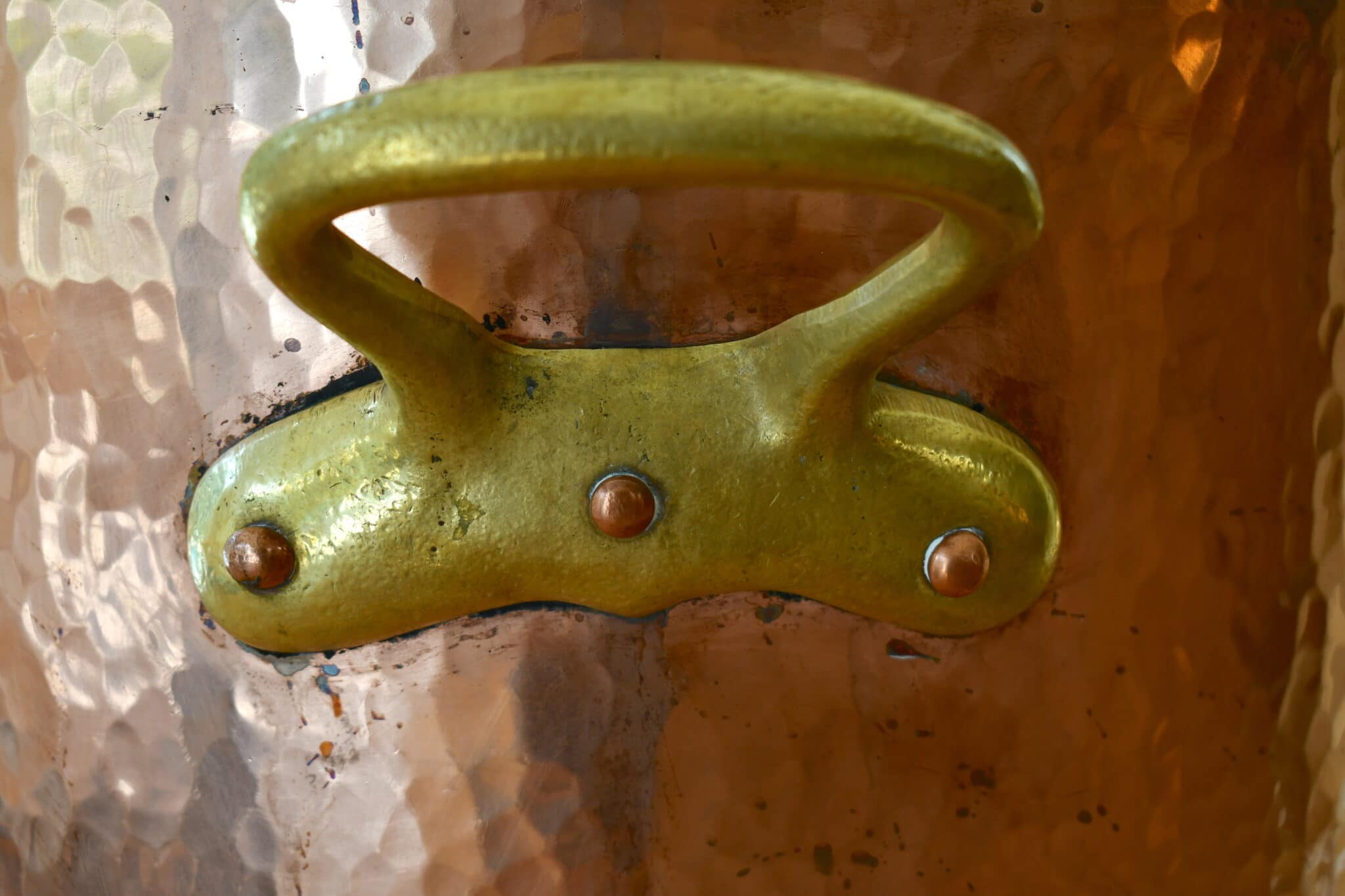
 You will also see martelage on pieces that don’t need it. It is of course possible to apply martelage to any metal, including copper bimetal or stainless steel pans that don’t need structural reinforcement. As an example, the round gratin shown at right is from Mauviel’s M’Elite series of cookware introduced in 2024 that according to Mauviel is made of stainless steel with interior layers of aluminum. These pieces need no hardening, but Mauviel has nevertheless chosen to apply a hammered finish.
A part of me is glad to see this. Any marketing trend that glorifies the French aesthetic is a sign of perceived consumer desire (or an attempt to inspire it), and we in the vintage and antique copper cookware community should welcome an influx of enthusiasm. But if you are looking for that gorgeous hammered look, why not get the real thing?
Conclusion
This post has been a passion project for me that has taken me many, many hours to research and write. My goal with this post is a practical one: I believe martelage was an intentional choice by the French chaudronneries, and understanding this intention will help you to characterize pieces by sight.
Some key points:
- Age: Martelage began appearing on French pieces at the end of the 19th century. If you don’t see defined horizontal rows, the piece could be hand-hammered, which would make it 1890s-1930s or so (with the exception of the work of small coppersmiths who still practice it); if the rows are straight across, it’s likely machine-hammered and made from the 1940s to the present.
- Thickness: Pieces with martelage are often, but not always, 2.5mm thickness or more. Look for additional clues such as handle material — a cast iron handle is more likely to be a restaurant-grade extra fort piece.
- Composition: On vintage French pieces, martelage almost always indicates a tin- or silver-lined piece, because bimetal pans (copper lined with steel, nickel, or aluminum) do not need the structural reinforcement of work-hardening.
As always, identifying and dating copper cookware is a process of looking at multiple characteristics of a piece. But of these characteristics, martelage is one you can spot from a distance. It’s often the first thing I notice about a piece and the first consideration I use to narrow down the possibilities of what a piece could be. I hope this guide helps you explore and characterize antique and vintage copper for yourself.
A few notes.
Pure copper’s recrystallization temperature is 619°F (326°C), but if copper is alloyed or if there are trace impurities, the crystallization point may change. Also, annealing of copper is usually conducted at slightly higher temperature of 662°F (350°C) or more.


Another expertly researched article from VFC! I will now start taking a closer look at the martelage on some of the pans in my collection.
Super, Danke an VFC, ich habe die gleiche Idee wie Stephen…
For me, beautiful hammering has always been an essential criterion when buying a pan. A friend once said that hammering makes the copper appear alive. Thank you for your efforts in putting together this interesting article with sample photos from different periods.
I always enjoy your articles, so meticulously researched and look forward to new ones. You have been foundational in my copper cookware education. Thank you so much. I’m in awe of your knowledge and collection. A frustrating note since your site has been reorganized is that many of the old links no longer work, at least on my iPad and Mac laptop. Photos of pieces intended take us to your previous articles, (I count 19 in this article) show the following message: “This page doesn’t seem to exist. It looks like the link pointing here was faulty. Maybe try searching?” Am I the only person experiencing this difficulty?
Thank you for your kind words. The broken links are my fault — I reorganized the site without thinking through what the changes meant for the existing links across the site, and I don’t quite know what to do about it except to go through each post by hand to fix the links. I will work on this over the holidays. But everything is still here! I did not delete anything, but just moved things around. I know it’s been frustrating for readers and I apologize — I did not realize this would happen.
EDITED: I figured it out — a link format setting got flipped. I think the links throughout the site should work — I am so sorry for the problems!
MERRY CHRISTMAS to all friends of VFC!
I would especially like to express my gratitude to the wonderful editor of this unique and remarkable website.
HAPPY NEW YEAR IN PEACE AND HEALTH!
Thank you, Martin! Best wishes to you and all VFC readers for a wonderful 2026!