
Guest post: Gerhard’s Trio Infernale
“They easily replace a dumbbell workout…”

“This is far thicker than the 2.5 mm at which modern stainless lined copper maxes out.”

“After a while I was quite astonished, when under the thick oxide layer suddenly a company stamp appeared.”

“So after a while of hesitation, I bought the two pans. Now you know what my good intentions are worth.”

Why do certain pans capture the imagination?

This historic kitchen is a valuable find for copper detectives.

Reader Javier O. introduces us to the Spanish coppersmith José Preckler and Sons.

Copper jelly moulds represent a field of collecting in their own right, related to but somehow separate from the general

Let’s look at how a 19th century stockpot was assembled by hand.

This is my first pot with a tap and I have to say, I am absolutely delighted with it.

I’m covering both Benham & Sons and Benham & Froud in the same field guide because the two firms are

“At first, only the words ‘castle kitchen’ caught my attention.”

The stamps tell the story of this lovely railway pan.

A historical house, a famous owner, a bygone maker — for me, this pot hits the trifecta.

This pot is both lovely and sturdy, befitting its Swiss-English heritage.

These sea-faring saucepans — English-made and nickel-lined — belong to reader Roger W.

Like H. Pommier himself, this saucepan has a lot of Van Neuss DNA in it.

H. Pommier, a coppersmith in Brussels, Belgium, continues a long lineage: Van Neuss in the 19th century, and Vernimmen in

The “Brux” is for Bruxelles where the chaudronnerie Peter made beautiful copper.
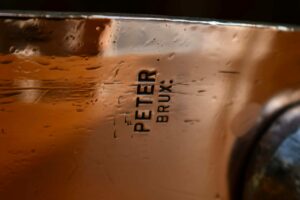
Peter was a coppersmith and kitchenware manufacturer based in Brussels, Belgium (the “Brux” in the stamp) from 1933 to 2006.

This beautiful piece puts me in mind of the story of why I started cooking with copper.

H. Pommier is Belgian, not French, but this Windsor is every bit as beautiful as its French cousins.


