Guest post: Gerhard’s lucky find
“I hadn’t noticed the maker’s mark, and I’m pretty sure the dealer hadn’t noticed it either.”
“I hadn’t noticed the maker’s mark, and I’m pretty sure the dealer hadn’t noticed it either.”

Yes, you read that right: it’s almost 20 inches across, and that’s just the body of the pan.

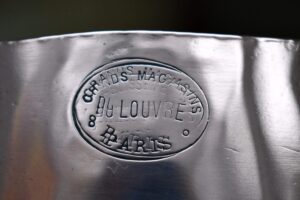
Okay, stamp detectives, get out your magnifying glass — you’ll need it for this one.

This little pot holds a lot of interest for me.

Readers Martin and Nick figured out the provenance of the monogram on this little pot.

When a seller underestimates the quality of a piece, it can mean that a deal is to be had.

This hefty sauté pan is a beautiful example of 1920s-1930s copper.

This is my first pot with a tap and I have to say, I am absolutely delighted with it.

This Paris-made pan began its career on trains in Spain and Portugal.

This is one of the first pieces Dehillerin ever made.

The weight of this piece and its details make it exceptional.

This pot hasn’t just been repaired — it’s been remade.

Help me get a handle on the handle on this helper-handled pot. Heh.
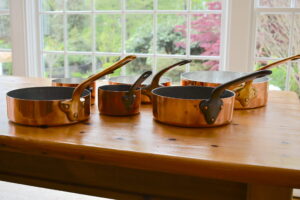
Three 19th-century department stores, three lines of custom copper cookware.

This lovely cocotte has graceful touches that mark it as an antique pre-war piece.

A historical house, a famous owner, a bygone maker — for me, this pot hits the trifecta.

This little stewpot carries a very early Dehillerin stamp that I had never seen before.

These two big pots are a master class in 20th century Gaillard coppercrafting.

These beautiful saucepans and lids are everyday masterpieces from a lesser-known Parisian atelier.

These two pans have a wonderful secret: they’re bottom-heavy.

These sea-faring saucepans — English-made and nickel-lined — belong to reader Roger W.

I think these are the work of young Jules Gaillard at the start of his forty-year career.

Like H. Pommier himself, this saucepan has a lot of Van Neuss DNA in it.